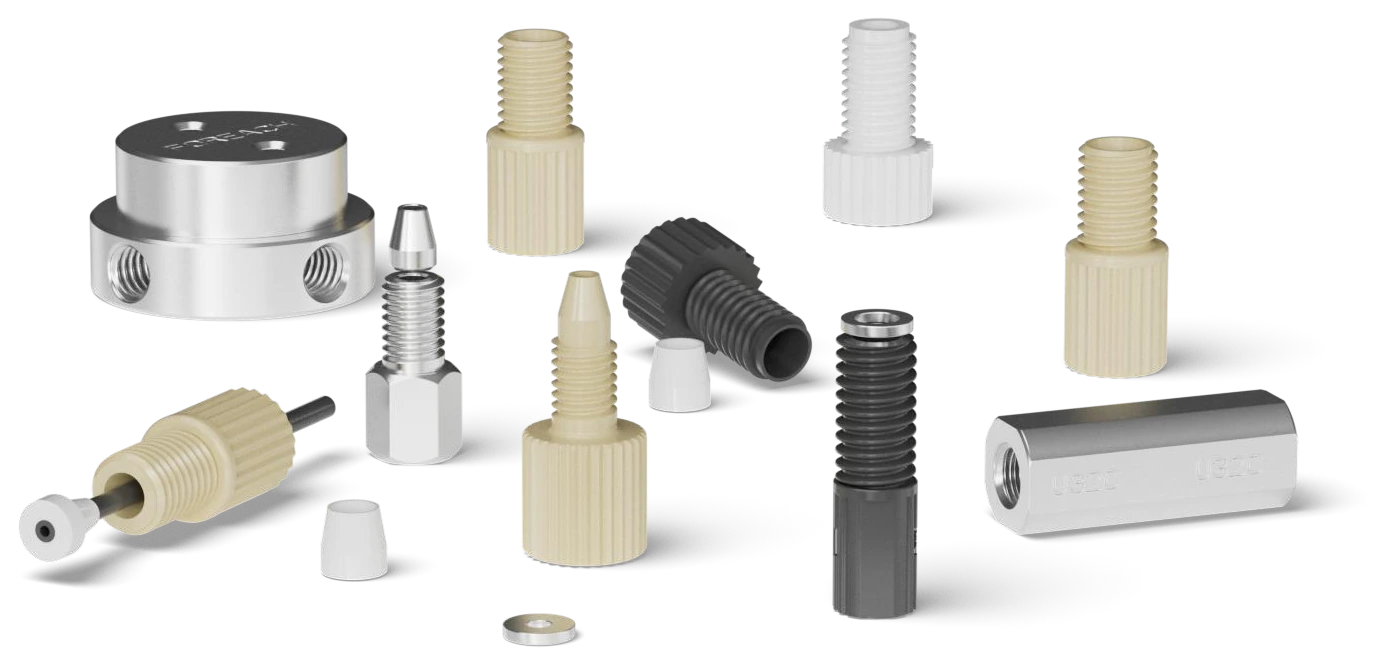
FOREACH hard tube fittings, also described as rigid tubing fittings, connect PTFE, FEP, PFA and PEEK tubing in IVD, life science, laboratory automation and analytical instruments. They connect pumps, valves, fluidic manifolds and other equipment ports in reagent delivery, sample handling, washing, circulation and drainage lines. Different sealing designs and tube-end connections accommodate fixed internal tubing, confined installation spaces and removable tubing assemblies. High-pressure models serve analytical fluid paths such as HPLC and are selected to match system pressure and port geometry for tubing connections, port adaptation and branch connections.
The range comprises flanged flat-bottom, ferrule, retaining-ring and high-pressure fittings. Flanged flat-bottom designs seal at the port bottom through a pre-flanged tube end and matching gasket. Ferrule designs grip the tube without pre-flanging; retaining-ring designs secure the tube end with a fitting, retaining sleeve and washer. Common tubing ODs are 1.6, 2.0, 2.5, 3.0 and 3.2 mm, with M6×1 and 1/4-28 UNF threads and standard or compact bodies. High-pressure options include fittings for 1.6 mm OD tubing and 10-32 UNF coned ports, as well as high-pressure unions and tees. Body materials include PVDF, PPS, PEEK, POM and stainless steel according to design and model; PP and ETFE ferrules are also available. Gaskets and retaining-ring sets must match the connection design. FEP and PTFE tubing can be supplied as custom tubing assemblies with specified lengths, single- or double-flanged ends, retaining-ring connections, locating sleeves and line identification.
High-pressure models offer pressure ratings up to 34 MPa; select the appropriate configuration according to system pressure, the specific model, tubing, port geometry and assembly method. Sealing depends on the fit between tube OD, tube-end preparation, seals and the equipment port. Square-cut ends and correct positioning help reduce dead volume at the connection. Some flanged and retaining-ring designs allow the fitting to rotate relative to the tubing, reducing tube twist during tightening, and permit repeated disassembly according to their assembly requirements. Ferrules must be used in accordance with the single-installation requirements of the corresponding design. Select wetted tubing and seals for the composition, concentration, temperature and contact time of process and cleaning fluids, then confirm the sealing performance and pressure capability of the complete tubing assembly as installed.