
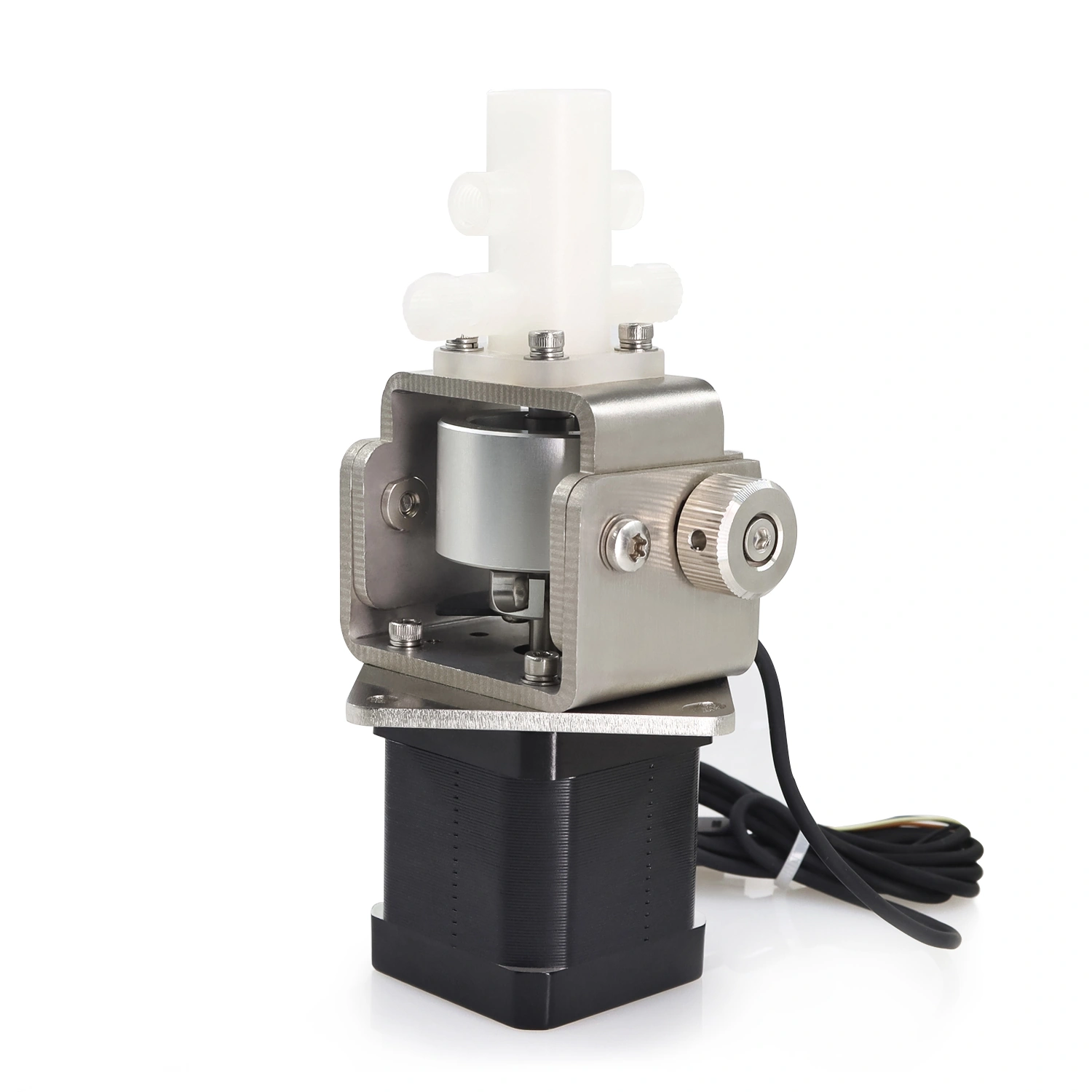
Automated analysis and in vitro diagnostics: reagent dispensing
In automated analyzers and in vitro diagnostics (IVD) reagent circuits, liquid travels from a reagent bottle through the pump, tubing and dispensing tip into a reaction vessel. The component may be specified as a reagent dispensing pump or reagent dosing pump. Define the volume required by each analytical step and the time available to deliver it, not only the flow per minute.
Displacement and complete operating revolutions determine nominal dose volume. Calculation example: 100 μL/rev × 5 revolutions = 500 μL. At a constant 150 rpm, those revolutions take 2 seconds, excluding acceleration, stopping and other machine actions. This is a sizing calculation, not measured performance. Recalibrate output after changing the displacement setting.
Priming the working-fluid path and washing the piston area are different operations. Priming establishes a stable liquid column; the wash circuit addresses residue around the piston. For salt-containing or crystallizing reagents, select a compatible cleaning liquid and shutdown sequence. A wash port does not establish compatibility with every corrosive liquid.