
What Is a Valveless Metering Pump? Working Principle, Applications and Selection
A valveless metering pump is a positive-displacement pump that combines rotary and axial reciprocating piston motion to switch the fluid path, draw liquid in and discharge it. Its pumping mechanism does not rely on conventional inlet and outlet check valves. It can serve reagent dispensing, titration, filling and two-fluid proportional delivery, but metering performance still has to be verified with the actual fluid, pressure, tubing, drive and cleaning conditions.
01How does a valveless metering pump work?
The ceramic piston rotates while moving axially. Rotation alternately aligns the metering chamber with the inlet and outlet, while axial motion changes chamber volume. With the two motions held in the required phase relationship, the pump repeats a suction-and-discharge cycle.
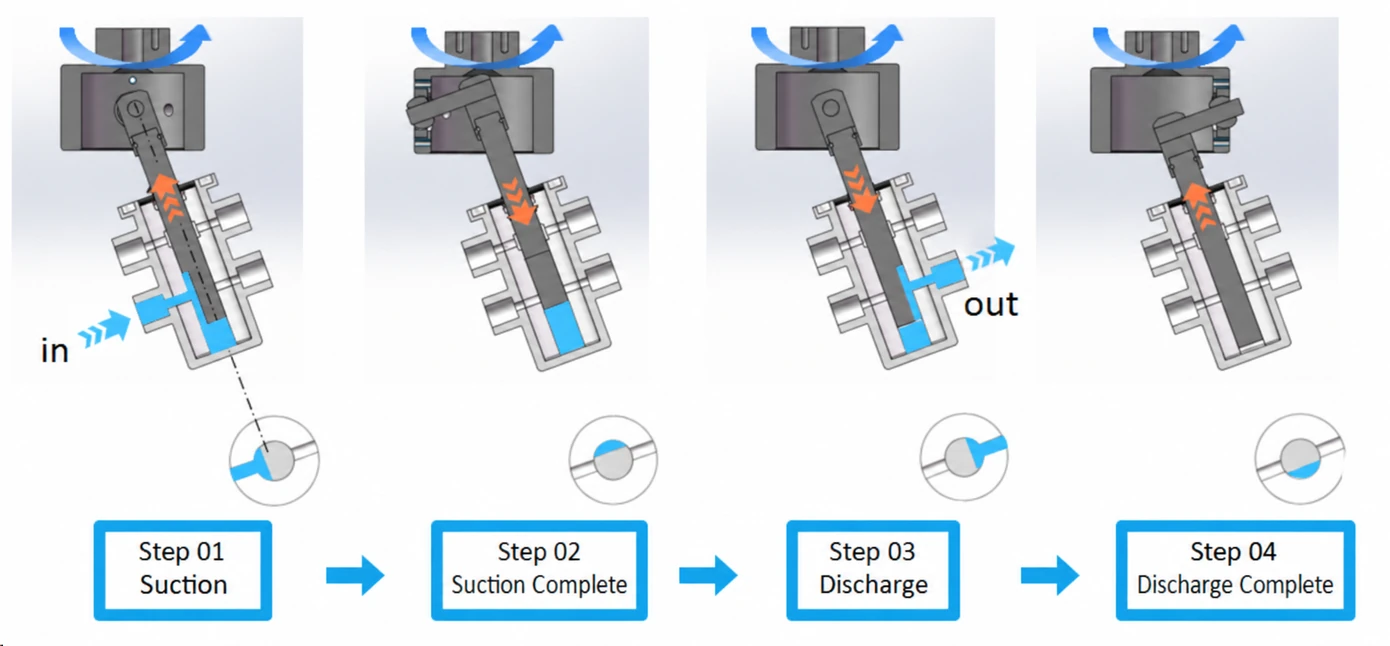
| Stage | Piston and port state | Fluid action |
|---|---|---|
| Prepare to aspirate | The chamber turns toward the inlet and the piston begins to retract | The inlet connects to the chamber |
| Aspirate | The piston continues retracting and chamber volume increases | Liquid enters the chamber |
| Switch the path | The piston rotates the chamber from inlet toward outlet | The inlet closes and the outlet prepares to open |
| Dispense | The piston advances and chamber volume decreases | Liquid leaves through the outlet |
Port geometry, motion phase and displacement adjustment depend on the pump-head design. This cycle explains the principle, but the model specification and system test remain the selection authority.
02Displacement per revolution, dose volume and average flow
Valveless metering pumps commonly express displacement in μL/rev: the nominal volume delivered during one complete rotational cycle at the current setting. Dose volume also depends on the number of revolutions, while average flow also depends on rotational speed. These are three different quantities.
Dose volume = displacement per revolution × revolutions
Keep volume units consistent. This is a nominal estimate for complete cycles.
Average flow = displacement per revolution × rotational speed
Using μL/rev and rev/min gives μL/min.
03Benefits and limits of the valveless mechanism
| Engineering point | Potential value | Boundary to check |
|---|---|---|
| No conventional check valves in the pumping mechanism | Reduces dependence on valve seating and valve-element motion during each pumping cycle | Particles, crystallization and deposits can still affect ceramic fits and ports |
| Coupled rotary and reciprocating motion | Combines path switching and positive displacement in one pump head | Requires correct drive positioning, phase and complete working cycles |
| Ceramic piston assembly | Supports repeatable metering with wetted materials selected for the fluid | Compatibility depends on concentration, temperature, exposure time and cleaning fluid |
| Mechanical displacement and speed adjustment | Matches both dose volume and process timing | Settings still require gravimetric or volumetric calibration in the real fluid path |
Valveless does not automatically mean pulsation-free, dry-running capable, clog-proof or suitable for any viscosity or backpressure. Poor inlet supply, bubbles, outlet resistance, deposits and an unsuitable cleaning method can still change delivery stability and service life.
04Where are valveless metering pumps used?
| FOREACH series | Current shown configuration | Typical duty |
|---|---|---|
| RPL-P4 | 12–80 μL/rev, single head | Small-volume reagent addition, titration and repeated dispensing |
| RPL-P6.35 | 50–300 μL/rev, single head | Reagent dispensing, titration and quantitative filling |
| RPL-P15 | 300–1200 μL/rev, single head | Larger liquid additions, buffer addition and metered transfer |
| DRPL-0109 | Dual head, 1:9; 100 μL + 900 μL | Proportional delivery of concentrate and diluent |
| DRPL-0119 | Dual head, 1:19; 60 μL + 1140 μL | Two-fluid delivery at a higher dilution ratio |
05How to select a valveless metering pump
- Define the duty first: discrete dosing, titration, filling, continuous supply or proportional delivery of two liquids.
- Set the target dose, allowed delivery time, daily cycle count and acceptable error, then calculate the required displacement, revolutions and speed.
- Record fluid identity, concentration, viscosity, particle or crystallization risk, working temperature, cleaning fluid and idle time.
- Record reservoir level, suction lift, tubing length and bore, plus outlet restrictions from filters, needles, mixers and other components.
- Confirm wetted materials, working and wash ports, mounting, motor and control method, separating the shown configuration from project-specific options.
- Measure dose output, repeatability, timing, bubbles, leakage and cleaning recovery in the actual fluid path before freezing production settings.
06Installation, commissioning and maintenance checks
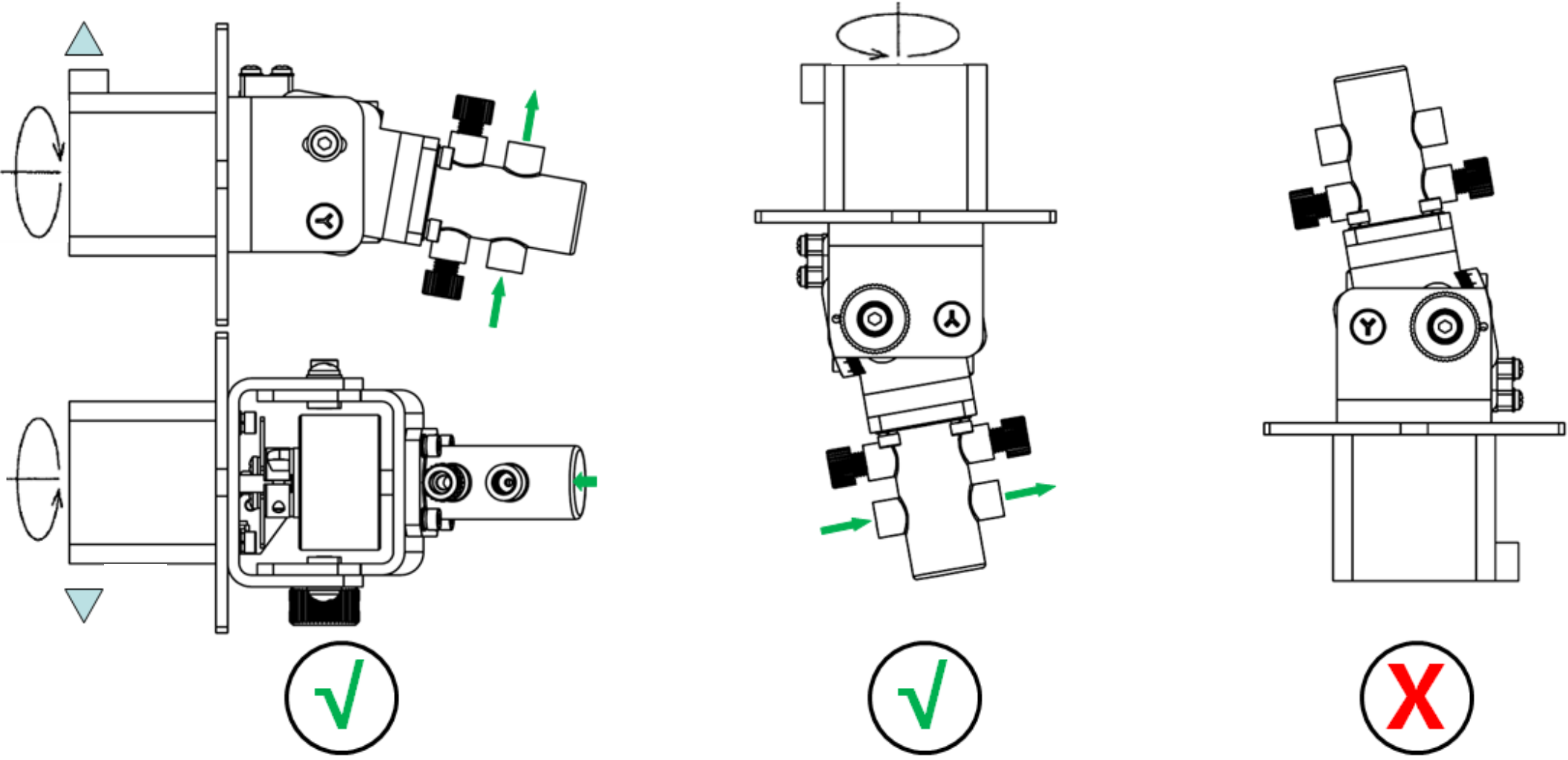
- Remove air from the inlet tube and pump chamber before evaluating dose accuracy, so bubble volume is not mistaken for pump error.
- Maintain stable inlet supply and avoid excessive lift, long narrow tubing or a blocked filter that creates excessive inlet pressure drop.
- Do not treat a pressure-withstand value as the permitted continuous working backpressure; use the specification definition and a real fluid-path test.
- For crystallizing, depositing or frequently changed fluids, define shutdown flushing, cleaning-fluid compatibility and waste handling.
- Document fluid, temperature, displacement setting, speed, backpressure, cycle count and measurement method so the acceptance result can be reproduced.
07Products and further selection guidance
08Valveless metering pump FAQ
How is a valveless metering pump different from another metering pump?
The main difference is the pumping and switching mechanism. A valveless metering pump uses rotary and reciprocating piston motion to switch between inlet and outlet while changing chamber volume, without conventional inlet and outlet check valves. Other metering pumps may use check valves, diaphragms or different mechanisms. Selection still depends on dose, pressure, fluid and control requirements.
Does a lower displacement per revolution always mean a smaller minimum dose?
No. Displacement per revolution is the nominal output for a complete cycle. The minimum reliable dose also depends on motor positioning, backlash, fluid, tubing, bubbles, the needle tip and measurement method. Confirm it with repeated-dose testing under the target conditions.
Does valveless mean the complete instrument never needs a valve?
No. Valveless describes the pumping mechanism. The complete system may still require switching, isolation, backflow-control or safety valves depending on supply, cleaning, return and safety functions.
What is the difference between RPL and DRPL?
RPL is a single-head valveless metering pump for one metered fluid path. DRPL is a dual-head configuration for delivering two liquids at a specified volume ratio. Two-stream metering and downstream mixing are separate functions and should be validated separately.