
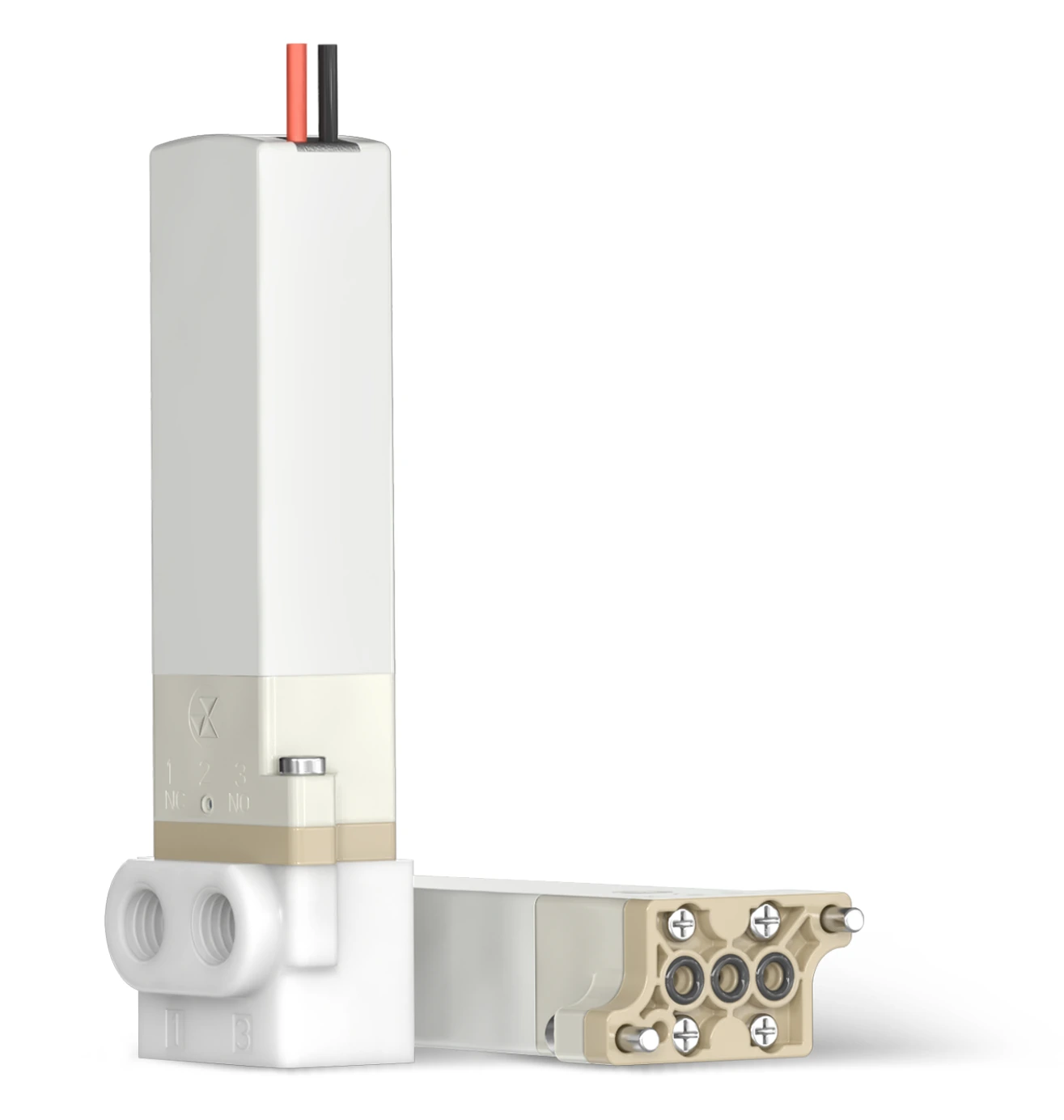
FOREACH 3-way miniature diaphragm solenoid valve for switching a common port between two flow paths
FOREACH SV10 3-way miniature solenoid valves use a rocker diaphragm to switch a common port between two other ports. They select reagent or wash-fluid connections in automated equipment.
Connect the common port to the shared line and the other ports to the two paths to be selected. Coordinate switching with the pump and equipment program. Three ports describe the connection arrangement; they do not mean three simultaneous flows or proportional mixing.
Choose SV10-P for manifold mounting, SV10-M6 or SV10-U28 for threaded fittings, or SV10-B16 for flexible tubing. Confirm the common port and energized/de-energized connections, then select wetted materials and a 12 V DC or 24 V DC coil version.
Choose EPDM, FKM or FFKM diaphragms and matching O-rings for the actual reagent and cleaning fluid. Base-mounted and barbed versions use a PEEK base plate. Threaded versions offer additional valve-seat materials; PFA seat or base-plate configurations require a separate configuration check.
Typical Applications:
3-way solenoid valves for reagent and wash-fluid switching, Connection planning: identify the common port, Equipment integration: manifold or tubing connections
| Model family | SV10-3 |
|---|---|
| Valve structure | Rocker diaphragm valve |
| Ports and function | 3-way universal |
| Connection | Manifold mounting face; M6 / 1/4-28 UNF; Barbed; tubing ID 1.5–2.0 mm |
| SV10-P | Manifold mounting face. The PEEK base plate seals against the mating manifold. Match the port layout, locating holes and seals to the selected 2-way or 3-way version before designing the mounting face. |
| SV10-M6 / SV10-U28 | M6 / 1/4-28 UNF. Choose M6 or 1/4-28 UNF fittings to match the valve. Recommended thread engagement is 5 mm and tightening torque is 0.25–0.3 N·m. Use a suitable sealing washer at the bottom seal. |
| SV10-B16 | Barbed; tubing ID 1.5–2.0 mm. Use flexible tubing with an internal diameter of 1.5–2.0 mm, hardness of 55–65 Shore A and outer diameter below 4.5 mm. A custom mounting bracket is available for integration into the equipment. |
| Operating pressure | -75 kPa – 0.25 MPa |
| Orifice diameter | 1.4 mm |
| Chamber volume | 20 μL |
| Flow coefficient Cv | 0.03 |
| Diaphragm and O-ring options | EPDM / FKM / FFKM |
| Base plate | PEEK; PFA for threaded versions by configuration |
| Threaded valve-seat options | PVDF / PTFE / PMMA / POM / PEEK; PFA by configuration |
| Rated voltage | DC 12 / 24 V (±10%) |
| Standard power | 2.5 W |
| Power-saving circuit | Start: 2.5 W; hold: ≤1 W |
| Standard response time | ≤15 ms, no load |
| Power-saving response time | ≤25 ms, no load |
| Ambient temperature | 0–50 °C |
| Fluid temperature | 0–50 °C, non-freezing |
| Coil insulation | F |
| Weight | SV10-P: 30 g; SV10-M6 / SV10-U28: 39 g; SV10-B16: 29 g |
| Response test conditions | 25 °C, rated voltage, maximum operating pressure with air, common port pressurized. Response varies with fluid, pressure, tubing and temperature. |
Typical Applications
FOREACH SV10 3-way miniature solenoid valves use a rocker diaphragm to switch a common port between two other ports. They select reagent or wash-fluid connections in automated equipment.
3-way solenoid valves for reagent and wash-fluid switching
A 3-way valve can connect a common line alternately to reagent and cleaning fluid. After the reagent step, switch to the wash connection and use the pump to flush the shared tubing.
Set wash volume and repetitions according to the fluids, tubing length and acceptable residue, and check the result using the actual cleaning cycle.
Connection planning: identify the common port
Identify the shared line and the two paths to be selected. Check which ports connect with power applied and removed, then coordinate valve switching with the pump sequence.
Equipment integration: manifold or tubing connections
Use the base-mounted version when combining valves on a fluidic manifold. Choose threaded connections for tube fittings, or barbed connections for flexible tubing.
Plan access for installation, tubing replacement and wiring. The three connection styles serve different layouts while retaining the same choices of 2-way or 3-way function.
Tell us about your application
Describe which liquid must flow at each step and what should happen when power is removed. Include the connection drawing, fluids, pressure, temperature, supply voltage and installation space.
Compare 2-way and 3-way solenoid valves
2D Drawing Not Available Yet
To request a 2D drawing for this product, please click “Add Drawing” above.
Datasheet not yet available
The datasheet for this product has not been uploaded yet.
Frequently Asked Questions
Connect the common port to the shared line and the other ports to the two paths to be selected. Coordinate switching with the pump and equipment program. Three ports describe the connection arrangement; they do not mean three simultaneous flows or proportional mixing.
Configure your SV10 solenoid valve
Match the valve function, connection, wetted materials and voltage to your equipment.