
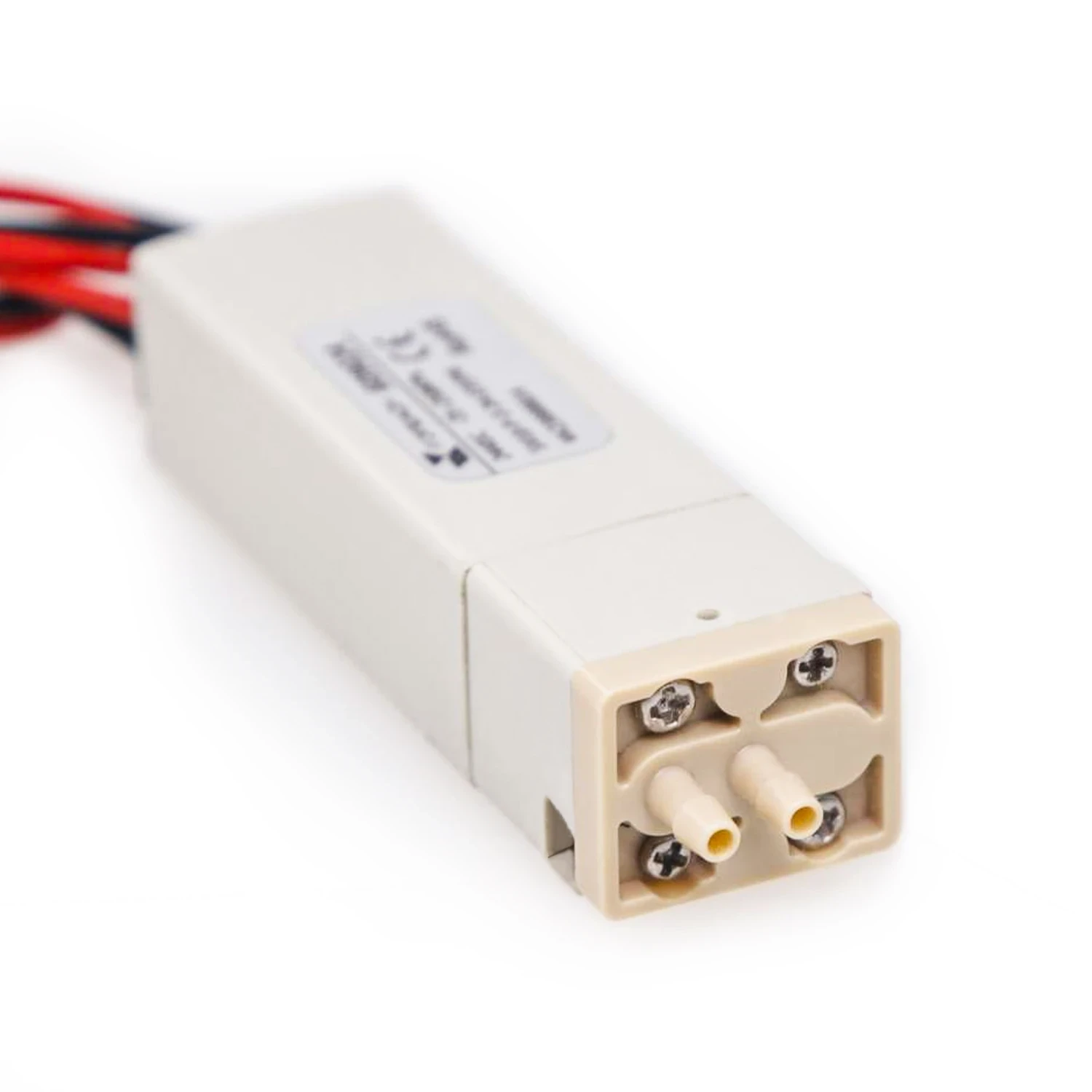
2-way normally open barbed miniature diaphragm solenoid valve with a PEEK base and barbed tubing ports, for supply lines that remain open and close temporarily on a control signal
The SV10-B16-2NO normally open 2-way valve keeps a reagent or wash-fluid line open when power is removed and closes it when energized, allowing the instrument to interrupt delivery as needed. The valve opens or closes the fluid path; a pump or pressure difference moves the liquid. Coil options are 12 V DC or 24 V DC.
Use flexible tubing with an internal diameter of 1.5–2.0 mm, hardness of 55–65 Shore A and outer diameter below 4.5 mm. A custom mounting bracket is available for integration into the equipment. This configuration has a PEEK base plate, with EPDM, FKM or FFKM options for the diaphragm and matching O-rings. Check material compatibility against the reagent and wash-fluid composition, concentration, temperature and contact time.
Typical Applications:
2-way solenoid valves for reagent on/off control, Power-off behavior: normally closed or normally open, Equipment integration: manifold or tubing connections
| Configuration family (not a complete ordering code) | SV10-B16-2NO |
|---|---|
| Valve structure | Rocker diaphragm valve |
| Ports and function | 2-way normally open (NO) |
| Connection | Barbed; tubing ID 1.5–2.0 mm |
| Operating pressure | -75 kPa – 0.25 MPa |
| Orifice diameter | 1.4 mm |
| Chamber volume | 20 μL |
| Flow coefficient Cv | 0.03 |
| Diaphragm and O-ring options | EPDM / FKM / FFKM |
| Base plate | PEEK |
| Rated voltage | DC 12 / 24 V (±10%) |
| Standard power | 2.5 W |
| Power-saving circuit | Start: 2.5 W; hold: ≤1 W |
| Standard response time | ≤15 ms, no load |
| Power-saving response time | ≤25 ms, no load |
| Ambient temperature | 0–50 °C |
| Fluid temperature | 0–50 °C, non-freezing |
| Coil insulation | F |
| Weight | 29 g |
| Response test conditions | 25 °C, rated voltage, maximum operating pressure with air, common port pressurized. Response varies with fluid, pressure, tubing and temperature. |
Typical Applications
2-way normally open barbed miniature diaphragm solenoid valve with a PEEK base and barbed tubing ports, for supply lines that remain open and close temporarily on a control signal.
2-way solenoid valves for reagent on/off control
In an automated analyzer, a 2-way valve can open the reagent line for a dispensing step and close it afterwards. Choose NC when the connection must be closed without power, or NO when it must remain open.
Coordinate the valve with the pump and equipment program. The valve controls the connection; the pump and its operating sequence determine the amount delivered.
Power-off behavior: normally closed or normally open
The normally open valve is open when de-energized and closes when energized. Use it for fluid paths that must remain open when power is off. The valve controls the connection; a pump or pressure difference drives the liquid.
Equipment integration: manifold or tubing connections
Use the base-mounted version when combining valves on a fluidic manifold. Choose threaded connections for tube fittings, or barbed connections for flexible tubing.
Plan access for installation, tubing replacement and wiring. The three connection styles serve different layouts while retaining the same choices of 2-way or 3-way function.
Tell us about your application
Describe which liquid must flow at each step and what should happen when power is removed. Include the connection drawing, fluids, pressure, temperature, supply voltage and installation space.
Compare 2-way and 3-way solenoid valves
Datasheet not yet available
The datasheet for this product has not been uploaded yet.
Frequently Asked Questions
The normally open valve is open when de-energized and closes when energized. Use it for fluid paths that must remain open when power is off. The valve controls the connection; a pump or pressure difference drives the liquid.
Fittings for volume orders and custom applications
Foreach can support fitting selection, volume supply, and customization based on port type, tube size, material, sealing element, mounting structure, and application conditions.