
Choosing Rotary Valve Wetted Materials: Head, Rotor and Seals
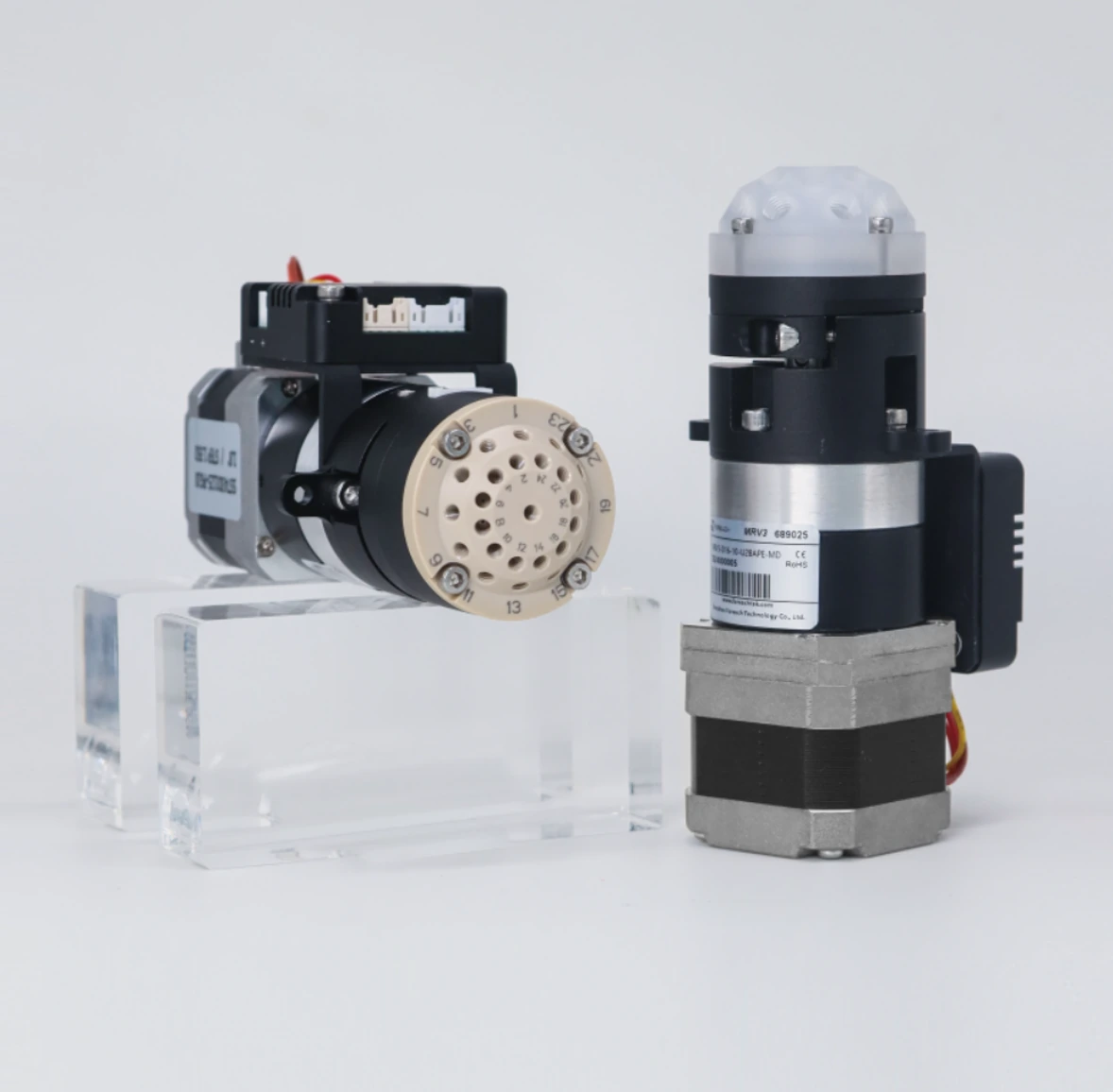
Select rotary-valve wetted materials from the complete material list. Check reagents, samples, wash and storage liquids against every component, then validate concentration, temperature, contact duration and switching conditions. Corrosion resistance of the head alone does not establish suitability of the whole valve.
A rotary valve changes liquid connections, so its materials are described as valve-head or wetted materials. The head, stator, rotor and any other wetted sealing parts have different functions and may use different materials. Assess each component separately, then evaluate the complete combination.
01List wetted components before focusing on the head
| Location to check | Information required | Why it affects material selection |
|---|---|---|
| Head and internal passages | Material, grade, fillers and modifications | Direct liquid contact requires chemical compatibility and structural stability |
| Stator, rotor and sealing faces | Specific material pairing and structure | Move relative to each other in contact with liquid while maintaining a seal |
| Other seals or connection parts | Wetted status, material and assembly location | One unchecked small component may limit suitability |
| Fittings, tubing and downstream components | Wetted-material list for the entire shared path | A suitable valve does not establish suitability of the complete fluid path |
Current MRV3 information distinguishes the PEEK/PCTFE head from the zirconia stator and sapphire rotor. The ordering diagram also codes the head material and rotor material combination separately. A PEEK head does not imply a PEEK rotor, and a ceramic sealing pair does not identify the head material.
Distinguish material names, grades and formulations
Beyond basic names such as PEEK or PTFE, the material list should state the grade and whether it is filled, reinforced or modified. Neat resins and composites can differ in mechanical performance, sealing and chemical suitability. The same general material name does not establish interchangeability.
The head and sealing pair perform different tasks and may use different combinations. When comparing configurations or replacing parts, check the head, stator, rotor and other wetted components separately. Do not extend a head-material compatibility conclusion to the entire valve.
02How should PEEK and PCTFE be compared?
| Candidate material | Properties useful for initial screening | Application-specific checks still needed |
|---|---|---|
| PEEK head | Mechanical performance and a broad chemical suitability range make it a candidate for precision fluidic parts | Specific solvent, acid or base, concentration, temperature, grade and mechanical loading |
| PCTFE head | A fluoropolymer with chemical resistance, dimensional stability and low-permeability properties | Target-liquid compatibility and machined-part behaviour under pressure, temperature and prolonged contact |
| Ceramic/sapphire sealing pair | Provides rotating contact and sealing; assess separately from the head | Ceramic type, pairing, media and particle effects on sealing operation |
A compatibility record for one solvent at room temperature does not establish suitability for a hotter mixed wash solution. Material heat resistance also does not replace the temperature limits of the assembled valve and driver. If both candidates pass media screening, compare mechanical fit, post-cleaning analytical results, available configurations and maintenance cost.
Broad descriptions such as organic solvent or acid/alkali reagent do not establish compatibility. Some solvents or strong acids can cause polymer swelling, adsorption or property changes, depending on formulation and exposure. Specify composition, concentration, temperature and contact duration. Raw-material or tubing records cannot directly define finished-head ratings.
03Assess working liquids, wash liquids and shutdown conditions together
| Input condition | What to record | Why it matters |
|---|---|---|
| Media composition | Complete formulation or main ingredients, mixing ratio and impurities | Liquids with equal pH may differ in solvent composition and oxidizing behaviour |
| Concentration and temperature | Normal range, maximum exposure and cleaning conditions | Room-temperature, low-concentration conclusions cannot simply be extrapolated |
| Exposure mode | Continuous immersion, intermittent delivery, shutdown retention and wet/dry cycling | Brief exposure and prolonged retention may have different effects |
| Particles and crystallization | Size, concentration, deposition and precipitation after drying | Chemical compatibility does not prove passages or sealing faces tolerate particles |
Assess whether salt buffers dry and crystallize during shutdown, samples adhere to shared paths, or two reagents precipitate when they meet. Include these factors in replacement and shutdown procedures. Any intermediate rinse must suit both adjacent liquids and all wetted components, not merely remove visible colour.
04What should be validated beyond corrosion resistance?
Sealing and movement under actual rotary conditions
Static immersion can reveal discoloration, swelling or surface changes, but cannot replace rotation testing under pressure. Relative movement and sealing contact require monitoring actuation resistance, internal and external leakage, and condition after repeated switching. Establish suitable model-specific test conditions before cycling.
Residue and leachables: effects on analytical results
An unchanged appearance does not prove the liquid composition is unaffected. For low-concentration analysis or background-sensitive reagents, assess adsorption, liquid background after contact, analyte recovery and residue after cleaning. Define measurements from the analytical method; corrosion resistance is not equivalent to no adsorption or leachables.
Complete-path checks: is the head really the cause?
If the first result remains biased after changing head material, inspect the rotor, stator, fittings, tubing and pump chamber. Long shared tubing, incomplete displacement and bubbles can cause similar symptoms. Separate material problems from fluidic-design problems rather than repeatedly replacing heads without improvement.
05From material screening to complete-system validation
- Create a material–media matrix. Obtain the complete wetted list for the exact ordering configuration and match every working, cleaning and storage liquid to each component.
- Check compatibility data for the same grade and conditions. Record source, concentration, temperature and contact duration. Treat unsupported combinations as requiring validation, not as compatible.
- Perform appropriate exposure tests first. Examine changes in mass, dimensions, appearance and liquid background as needed to eliminate clearly unsuitable candidates.
- Validate dynamic sealing and switching after assembly. With actual tubing, liquids and allowable conditions, check leakage, movement, flow and restart after shutdown.
- Run the full analytical or dispensing process. Use blanks, the first sample after switching and successive results to assess residue and repeatability against predefined instrument criteria.
Retain material grade, component pairing, exact valve model, conditions and acceptance criteria. Reassess validation after changes to wash formulation, temperature, grade or critical parts. A passed test supports the tested conditions, not every reagent and operating condition.
06How should MRV3 material options be confirmed?
The MRV3 ordering diagram uses PK for a PEEK head and PE for a PCTFE head, with separate sealing-pair combinations. Provide the complete designation rather than only an abbreviation such as MRV3-D10. Series options do not mean all channel, bore, material and driver combinations are interchangeable or stocked.
Provide FOREACH with the media list and actual conditions to assess candidate head and wetted-part options. If long-term exposure or cycling evidence is unavailable for a liquid, include it in prototype validation. The series name cannot substitute for compatibility evidence.
07Rotary valve material-selection FAQs
Is PEEK or PCTFE always better?
Neither can be ranked without the application. Screen specific composition, concentration, temperature, exposure duration and grade, then validate sealing, cleaning residue and analytical results. Confirm that the required model offers the corresponding combination.
Can a ceramic rotary valve contact every acid and base?
No. Ceramic types and sealing pairs differ, and other wetted parts may be polymers. Check the full material combination against the specific media conditions. Ceramic does not imply universal compatibility.
Will a corrosion-resistant head solve cross-contamination?
Not necessarily. Shared-path residue, adsorption, cross-port leakage and insufficient cleaning can also cause contamination. Locate the cause through the first result after switching, blanks and path checks before changing materials or the process.