
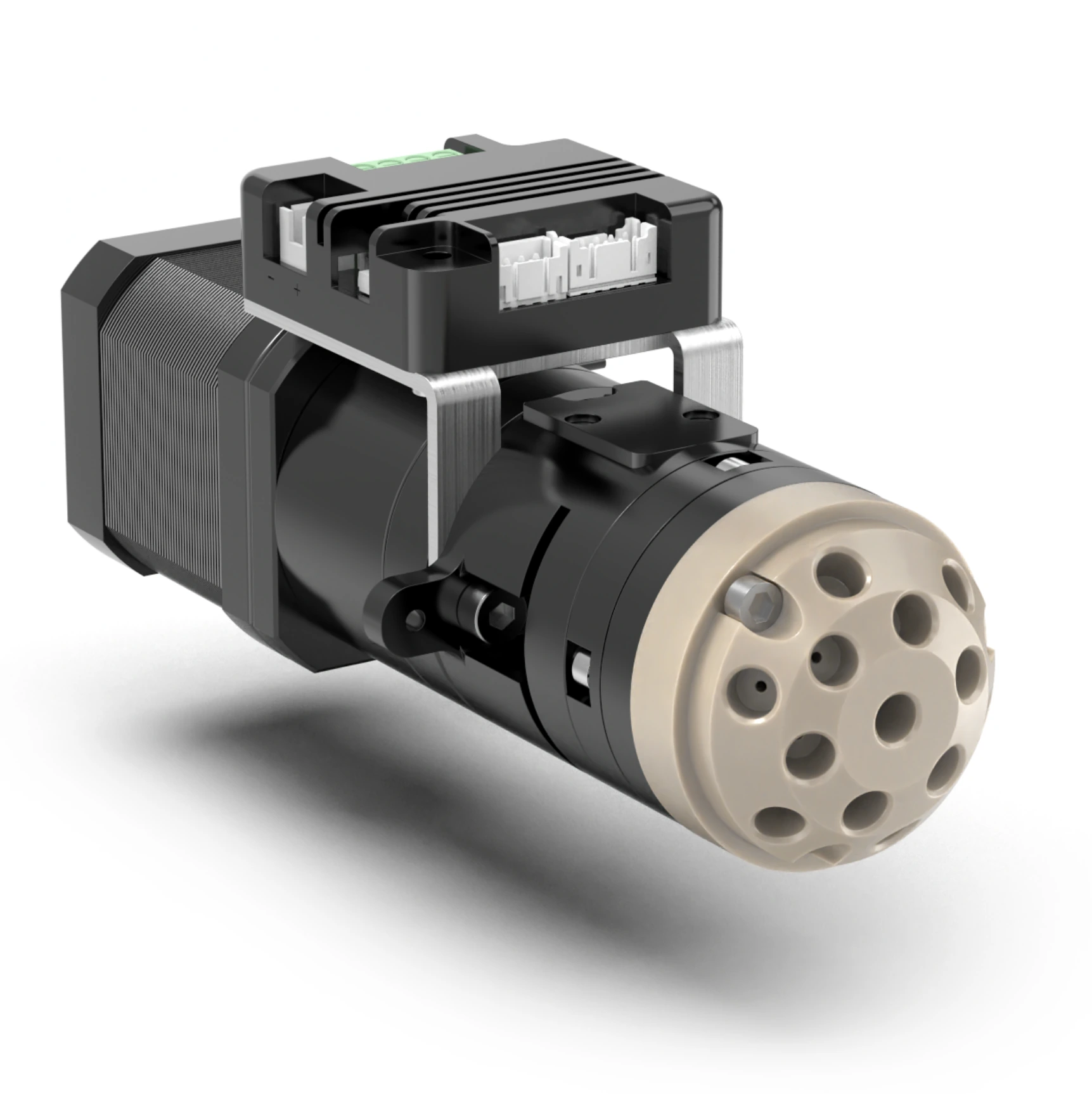
FOREACH 16-channel ceramic rotary selector valve for reagent selection and wash-path switching
FOREACH MRV3-D16 is a 16-channel ceramic rotary selector valve for integration into automated equipment. It supports reagent selection and wash-path switching in instrument fluidics and laboratory automation systems, working with a pump and the equipment control program to select reagent or wash-fluid connections in sequence.
The valve uses a zirconia stator and sapphire rotor, with motor-driven rotation to switch fluid paths. PEEK or PCTFE valve-head configurations allow wetted materials to be selected for the reagents, cleaning fluids and operating conditions.
For integration, use the flow diagram to establish connection requirements, then check bore size, port threads, internal volume and mounting requirements. Material combinations and specifications depend on the selected ordering model.
Typical Applications:
Reagent selection, Sample preparation, Sequential liquid distribution, Fluid-path flushing
| Model | MRV3-D16 |
|---|---|
| Product type | Ceramic rotary valve |
| Channels | 16 |
| Bore diameter | 1.0 mm |
| Internal volume | 10 μL |
| Port thread | 1/4-28 UNF |
| Pressure rating | 0.7 MPa |
| Valve head material options | PEEK / PCTFE |
| Stator / rotor | Zirconia ceramic / sapphire |
| Initial position | Automatic homing on power-up |
| Switching time | ≤2 s per revolution; <100 ms between adjacent ports |
| Service life | 1,000,000 revolutions |
| Motor / driver | Optional |
| Motor reduction ratio | 1:10 |
| Communication interface | RS232 / RS485 |
| Baud rate | 9600 / 57600 / 115200 |
| Power supply | DC 24 V / 2 A ±10% |
| Maximum power | 48 W |
| Ambient operating temperature | 0–50 °C |
| Operating relative humidity | 20–80% RH |
| Weight | Approx. 600 g |
| Internal volume definition | Volume of the COM-port passage and rotor groove |
Typical Applications
MRV3-D16 supports instrument workflows that need to switch automatically between liquid connections: selecting reagents, changing sample-processing steps or directing liquid to different destinations. The valve selects the connection, the pump moves the liquid, and the instrument program coordinates the sequence.
Analytical Instruments: Sequential Reagent Selection
An analytical method may require several reagents to be added in sequence. Connect the reagent reservoirs to separate channels so the valve can select the required reagent before the pump delivers it to a reaction vessel or detection unit.
MRV3-D16 provides the switching step so reagent connections can follow the analytical method. Allocate channels for both reagents and cleaning fluid; the paired pump and instrument program control the delivered volume and speed.
Sample Preparation: Switching Between Sampling, Reagents and Washing
Before analysis, a sample-processing sequence may require sample transfer, addition of processing liquids and washing of the connected tubing. Each step uses a different liquid connection and must be coordinated with pump aspiration and delivery.
MRV3-D16 can select sample, processing-liquid or wash connections in the required sequence. When samples pass through the valve, consider particles, material adhesion and the permitted residue between samples when designing the workflow.
Automated Liquid Distribution: One Supply, Multiple Destinations
When several vessels or instrument locations use the same liquid, a distribution valve can select their supply connections in sequence. After the pump completes delivery through one channel, the valve selects the next channel for the following delivery.
MRV3-D16 provides channel switching for this sequential supply arrangement. The instrument controls delivery volume, dwell time and order, while the channel count must accommodate the intended destinations and spare connections.
Repeated Operation: Flushing Between Reagents
When different reagents pass through shared tubing, a wash step can be included between reagent changes. Connect cleaning fluid to a channel, select it after the previous reagent step and use the pump to flush the valve and tubing before selecting the next reagent.
Include this wash step in the automated operating sequence. Set the amount of cleaning fluid and number of flushes according to tubing length, reagent properties and acceptable residue, then check the result using the actual liquids.
Tell Us About Your Application
Tell us which liquids the instrument uses, in what order, how many vessels or locations must be connected, and the volume and timing required at each step. Share a connection diagram, reagent and cleaning-fluid details, temperature, pressure, ports and available mounting space so we can match the channel configuration, valve-head material, motor and driver.
Compare MRV3 Configurations
2D Drawing Not Available Yet
To request a 2D drawing for this product, please click “Add Drawing” above.
Datasheet not yet available
The datasheet for this product has not been uploaded yet.
Frequently Asked Questions
The MRV3-D16 selects fluid paths for sequential reagent access, sample collection and distribution, and switching between reagent and wash connections. It works with a pump; the instrument control program coordinates valve positions with aspiration and delivery for automated fluidic modules.
Confirm Your MRV3 Configuration
Tell us which liquids and destinations your instrument needs to switch between so we can help select a valve configuration.