
What Is the Difference Between Rated Working Pressure, Maximum Output Pressure, Proof Pressure, and Burst Pressure for a Miniature Diaphragm Pump?
A pressure value has engineering meaning only when it is paired with a term definition, test fluid, inlet condition, corresponding flow rate, duration, and acceptance criteria. Rated working pressure can define an operating boundary; maximum output pressure, proof-test pressure, and burst pressure cannot be treated directly as continuous operating points.
Miniature diaphragm pump literature commonly uses Rated Pressure, Max. Pressure, Output Pressure, Proof Pressure, Pressure Test, and Burst Pressure. Chinese-language pages may group these under generic labels such as 'pressure,' 'maximum pressure,' or 'pressure resistance,' making it easy to compare data that describe fundamentally different boundaries in a single column.
A pressure parameter cannot be used for selection based on its numeric value alone. At minimum, confirm the test fluid, temperature, inlet pressure, corresponding flow rate, duration, duty cycle, and acceptance criteria. Even when two values are both listed as 600 kPa, different conditions mean they do not represent the same performance.
1. Why the Same 600 kPa Value Can Describe Completely Different Things
Actual working pressure answers how much pressure differential the pump must overcome in operation. Rated working pressure describes the operating range allowed or specified by a controlled specification under defined conditions. Maximum output pressure usually describes a performance endpoint. Proof-test pressure and burst pressure verify a structural boundary and a failure boundary, respectively. These terms answer different questions.
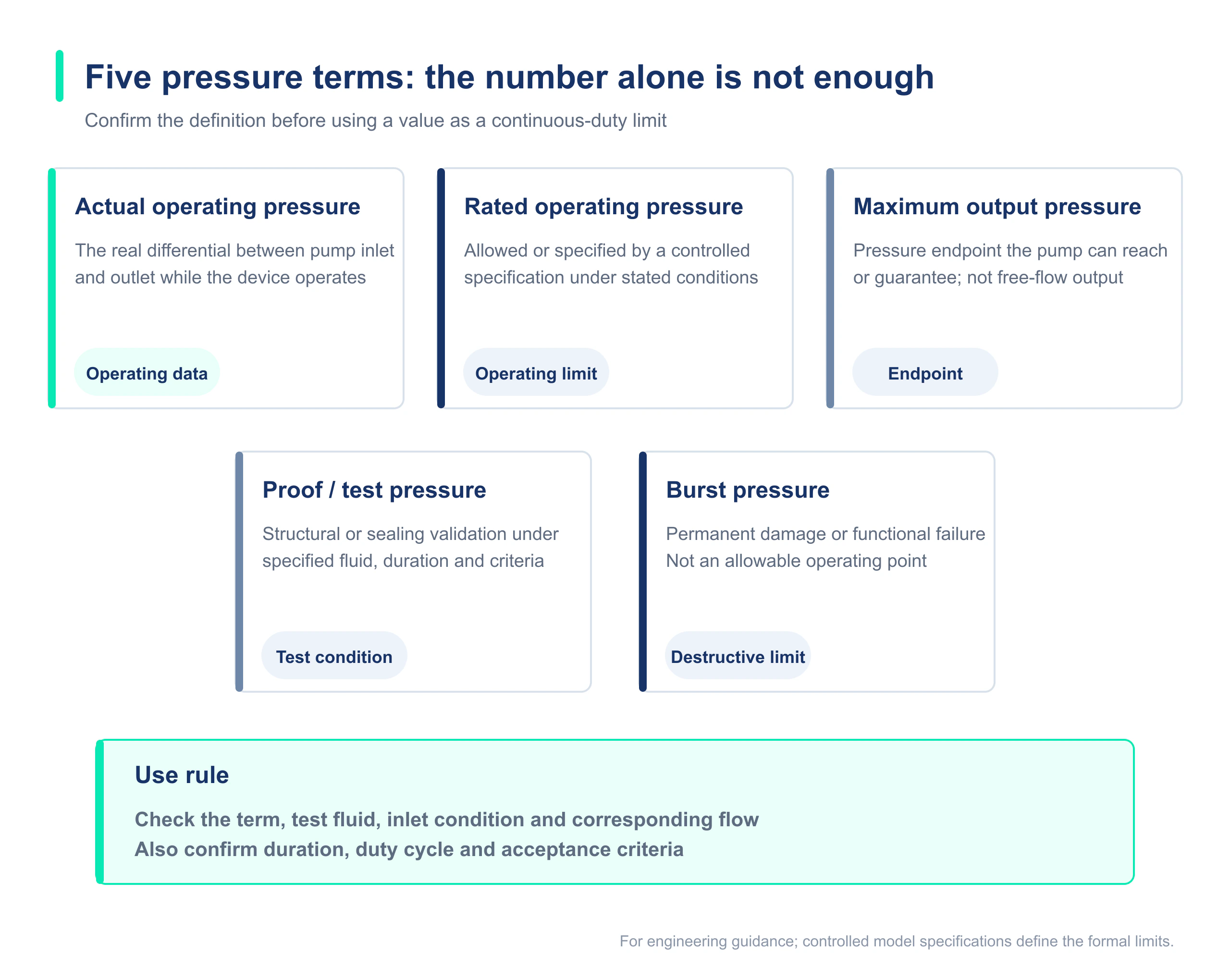
2. What Each of the Five Common Terms Actually Answers
| Term | Engineering meaning | Can it be used directly as a continuous operating point? | What must be clarified |
|---|---|---|---|
| Actual working pressure | The real pressure differential between the pump inlet and outlet while the equipment is operating | It is operating data that must be validated | Steady-state or transient condition, flow rate, and inlet condition |
| Rated working pressure | The operating pressure range allowed or specified by a controlled specification under defined conditions | It can define a boundary, provided all applicable conditions are observed | Fluid, temperature, duty cycle, and the flow-pressure curve |
| Maximum output pressure | A pressure endpoint or output-pressure range that the pump can reach or is guaranteed to meet | Normally not when stated by itself | Whether flow remains at that point and how long the condition may be sustained |
| Proof pressure or test pressure | A verification pressure applied to the structure or seals for a specified fluid, duration, and acceptance criteria | No | Test fluid, duration, and leakage or deformation criteria |
| Burst pressure | The boundary at which the specimen undergoes permanent damage or functional failure | Never | Specimen condition, pressure ramp rate, and failure criteria |
3. Why One Pressure Number Still Does Not Define Operating Capability
Take the Foreach DPL30H high-pressure liquid diaphragm pump as an example. The website lists a rated pressure of 600 kPa. This value must be interpreted together with the corresponding flow rate, fluid, inlet condition, temperature, duty cycle, and complete flow-pressure curve. It cannot be extended automatically to proof pressure, burst pressure, or continuous delivery capability under arbitrary conditions.
When literature lists Rated Pressure, Max. Pressure, Output Pressure, Pressure Test, or Burst Pressure, first confirm the field definition, then review the test conditions and acceptance criteria. Equal values only mean that the unit-converted numbers match; they do not establish equal engineering boundaries.
| Specification field | Minimum information that can be confirmed | What cannot be inferred directly |
|---|---|---|
| Rated Pressure / rated working pressure | The controlled specification defines an operating-pressure boundary under stated conditions | That no-load flow is maintained at this pressure or that the value applies to every fluid |
| Max. Pressure / Output Pressure | The literature provides a pressure endpoint or output-pressure range | That the value is allowable for long-term continuous operation |
| Pressure Test / Proof Pressure | The structure or seals underwent pressure verification under stated conditions | That the test pressure is the rated working pressure or burst pressure |
| Burst Pressure | The specimen's permanent-damage or functional-failure boundary | That the system's allowable working pressure may be increased on this basis |
4. Clarify at Least Nine Items When Reviewing a Pressure Parameter
- The term's formal definition in the controlled specification.
- Whether the test fluid is water, gas, or another liquid.
- Fluid temperature and ambient temperature.
- Whether the pump inlet is at atmospheric, negative, or positive pressure.
- The flow rate corresponding to the pressure and whether a complete flow-pressure curve is available.
- Whether the test is steady-state or transient, and its duration.
- Whether the duty cycle is continuous, intermittent, or permits only brief deadheading.
- Whether the acceptance criterion is continued delivery, no leakage, no deformation, or no burst.
- Whether sample count, power supply, tubing, and connections match the project conditions.
5. How to Avoid Misuse When the Specification Is Ambiguous
If a public page provides only one pressure value, first mark it as a 'parameter pending confirmation.' Do not classify it on your own as rated pressure, proof pressure, or burst pressure. Retain the controlled specification's exact wording in the project parameter table, and add fields for term definition, corresponding flow rate, duration, duty cycle, and acceptance criteria.
Foreach content follows the same principle: when the controlled specification publishes rated pressure, it is described as rated pressure. Undisclosed proof and burst values are not estimated from construction, materials, or similar parameters. A webpage can explain a selection method, but it cannot replace product-release documentation.
Foreach Resources and Evidence Boundary
FAQ | How Do Diaphragm Pump Pressure Terms Differ?
Is maximum output pressure the pressure at pump deadhead?
Some literature may define it as a performance endpoint near zero flow, but that cannot be assumed universally. Review the controlled specification, flow-pressure curve, and test method for the specific model.
If proof pressure is higher than rated pressure, can the pump operate continuously at a higher pressure?
No. A proof or pressure test normally has a specified fluid, duration, and acceptance criteria. It verifies the relevant structural or sealing boundary, not long-term operating performance or life.
Does a higher burst pressure mean a better pump?
Not by itself. Burst pressure is a failure boundary. Actual selection depends more on allowable working pressure at the target flow, fluid compatibility, service life, and the safety boundary of the complete fluid path.
Are 6 bar and 600 kPa exactly equal?
They are equivalent units: 1 bar = 100 kPa. However, terminology, test conditions, and duty cycle can differ between pages. Equal converted values do not mean the performance definitions are the same.
How should pressure fields be recorded in a project table?
Retain the exact controlled-specification wording and complete model number. Then add normalized fields for rated working pressure, maximum output pressure, proof or test pressure, burst pressure, flow at the target pressure, fluid, temperature, inlet condition, duration, duty cycle, and acceptance criteria.