
Is Clear PVC Tubing Compatible with Cleaning Fluids? Clouding and IVD Validation
Whether clear PVC tubing, also called clear vinyl tubing, can carry an IVD cleaning fluid depends on the compound, cleaner formulation, working concentration, temperature and contact time. Whitening or clouding after immersion alone proves neither failure nor acceptance. Compare appearance before and after rinsing and drying, then check dimensions, mass, hardness, fluid background, assembled seals and flow.
In clinical chemistry and chemiluminescence analyzers, wash tubing is both a wetted material and part of the assay workflow. FOREACH E3602007 PVC tubing illustrates test methods and observations for specified cleaners, concentrations and exposure methods, helping engineers design their own validation.
01Is PVC tubing resistant to cleaning fluids? What chemical compatibility testing must check
A cleaner can change tubing dimensions, hardness or surface condition, affecting barb fit and routing. The contacted liquid may also develop particles, discoloration or assay-background changes. These are different measurement targets; photographs after immersion cannot answer all of them.
| Question | Checks | Fluid-path relevance |
|---|---|---|
| Does the cleaner change the tubing? | ID, OD, mass, hardness and appearance | Check geometry and fitting engagement |
| Does the contacted liquid change? | Visible particles, color and application-specific indicators | Check for interference introduced by wetted contact |
| Does contact affect the assay workflow? | Unexposed cleaner blank, contact samples and assay background | Separate cleaner variability from tubing-contact effects |
| Will the installed assembly remain suitable? | Sealing, pull-off force, flow, pressure and actual wash cycles | Evaluate tubing, fittings, pump and routing together |
A chemical compatibility chart is a screening tool. Sample testing must use the actual formulation and conditions. Raw-material biocompatibility documentation does not replace cleaner exposure testing or prove that finished tubing cannot affect a particular reagent or signal.
02How do you test PVC tubing with cleaning fluids? Concentration, temperature and contact time
Two exposure methods were used: full immersion of the inner and outer surfaces, and filling the lumen. E3602007 was tested against TYGON ND-100-65 tubing. Cleaning fluid 1 and cleaning fluid 2 were each prepared with purified water as required. For each tubing material, each cleaner/exposure-method combination used 3 samples kept indoors in a cool, dry, ventilated location.
| Condition | Test setup |
|---|---|
| Full immersion | Short tubing sections fully submerged in prepared cleaner |
| Lumen filling | Cleaner filled into the tubing to observe internal-surface exposure |
| Fluid replacement | Changed daily; test and reference groups used the same preparation batch |
| Measurement intervals | After each 72-hour contact interval, specimens were removed, rinsed and air-dried for 24 hours as specified before measurement; results were recorded through 288 hours |
| Measurements | Appearance, liquid changes, ID, OD, mass and Shore A hardness |
Daily fluid replacement and removal for measurement after each 72-hour contact interval are separate operations. Replacement renews the contact fluid; rinsing and 24 hours of air-drying define the specimen condition for weighing and dimensional checks. Weighing wet tubing against a dry baseline introduces adhering-liquid mass, so sample preparation must be recorded.
This test used ID/OD changes within ±0.15 mm, mass within ±10% of baseline and hardness within 65±5A as acceptance limits, alongside appearance and liquid checks. A new device needs limits based on its dimensional tolerances, fitting interface and assay requirements; these values are not universal IVD standards.
03Can clear PVC tubing still be used after turning white? Appearance, mass and hardness checks
Distinguish whitening during contact from changes that remain after rinsing and drying. These samples recovered their original color without observed deformation or cracking. Suitability for a device still depends on wet-state clarity, dimensions, hardness, connections and assay criteria. Recovered clarity alone identifies neither the mechanism nor the complete validation outcome.
The following E3602007 mass changes were measured at 288 hours after rinsing and drying. Each range covers 3 samples; signs show the direction of change from initial mass.
| Cleaning fluid | Exposure method | E3602007 mass-change range |
|---|---|---|
| Cleaning fluid 1 | Full immersion | +0.02%~+0.05% |
| Cleaning fluid 1 | Lumen filling | −0.04%~+0.01% |
| Cleaning fluid 2 | Full immersion | 0.00%~+0.07% |
| Cleaning fluid 2 | Lumen filling | −0.02%~+0.03% |
E3602007 measured 70A both initially and after 288 hours in the full-immersion tests with both cleaners. Separate nominal hardness from an individual reading: 70A is at the upper limit of the 65±5A acceptance band and was unchanged in this measurement.
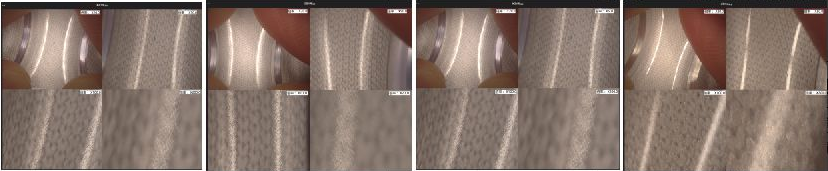
Both test and reference tubing showed surface whitening after immersion, before rinsing. Original color returned after rinsing with water and air-drying, with no observed deformation or cracks. Recovery after drying does not mean clarity stayed constant during contact. If bubbles must be seen through the wall, assess clarity while the tubing contains the actual fluid.
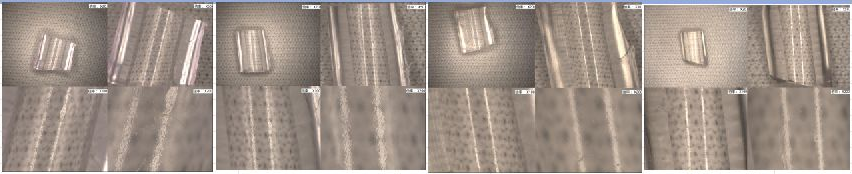
Weighing measures net mass change. A small change alone does not prove zero leaching or no material migration. Those questions require suitable analytical methods, detection capability and evaluation criteria.
04Can PVC tubing handle concentrated cleaner? Comparing 408-hour immersion with diluted cleaner
A separate test used customer-supplied clinical chemistry cleaner, both as supplied and diluted at 1:19, with E3602007 and reference tubing at ambient temperature and humidity. There were 4 groups. The planned procedure was removal, rinsing, drying, visual inspection and weighing every 3 days, followed by fresh cleaner and continued immersion.
The first contact interval was 48 hours; subsequent intervals were 72 hours, totaling 408 hours of fluid contact. Samples were removed and contact was paused during the schedule. Use cumulative contact time rather than describing the full calendar period as uninterrupted operation.
| Sample and fluid | Initial mass | Mass at 408 hours | Mass change |
|---|---|---|---|
| E3602007 / as-supplied cleaner | 589.36 mg | 590.01 mg | +0.11% |
| E3602007 / 1:19 dilution | 567.60 mg | 568.30 mg | +0.12% |
These endpoints show small net mass changes for the specific samples, exposure and weighing method. Sample numbers and conditions were limited; the result cannot be generalized to every PVC compound, cleaner concentration or long-term dynamic duty.
05Can PVC tubing affect chemiluminescence background? Testing against a cleaner blank
Exposure testing evaluates observable tubing changes; background testing also examines the contacted liquid. Each of two cleaners was tested as unexposed reference liquid, liquid contacted with FOREACH tubing and liquid contacted with reference tubing. Approximately 300 μL was measured daily on the same chemiluminescence analyzer platform.
The plan covered 14 days. The analyzer-supplied cleaner produced 11 days of valid data, and the customer cleaner produced 14 days. The table gives each group's minimum and maximum valid readings to describe background variation on that platform.
| Cleaner and valid records | Unexposed reference liquid | FOREACH tubing-contact group | Reference tubing-contact group |
|---|---|---|---|
| Analyzer-supplied cleaner / 11 days | 183~225 | 161~243 | 155~221 |
| Customer cleaner / 14 days | 94~162 | 101~165 | 90~162 |
The reference liquid also varies, so a single day's difference cannot automatically be attributed to tubing. No directional background trend was observed in the tubing-contact groups under these conditions. The ranges are descriptive, not proof of no interference in every assay, and do not replace sample testing, carryover assessment or device wash-performance validation.
06How do you validate an IVD wash line? From tubing compatibility to the installed device
Proceed from fluid contact to the connection assembly and then the assay workflow. Screen candidate tubing with the actual cleaner, pair exposed tubing with the intended fittings, and check washing, draining, idle periods and repeated operation in the device. This connects material observations with actual failure modes.
- Define the cleaner: name or safety data sheet, working concentration, preparation water, maximum temperature, longest idle contact and replacement procedure. List concentrate and working solution separately.
- Define the tubing: full part number, ID × OD, hardness, length and lot. Keep unexposed specimens as controls.
- Check connections: use the actual barbed fitting and insertion depth to retest sealing, pull-off force, flow and pressure, including device routing and tensile loads.
- Check the assay workflow: retain an unexposed-cleaner blank, define background and other relevant endpoints, and record repeatability and acceptance methods.
FOREACH can review PVC tubing and connection requirements for a project. The E3602007 values here are results from specified samples. FEP or other materials need their own dimensional, end-connection and actual-cleaner exposure assessment; PVC findings do not transfer automatically.
07When should compatibility be revalidated after changing the cleaner or PVC tubing?
Changing cleaner brand, formulation, concentration, preparation water, maximum temperature, longest idle contact or replacement frequency can change exposure outcomes. Even with E3602007, check whether the new conditions fall within validated coverage before choosing additional tests. Results for cleaning fluids 1 and 2 apply only to the respective tested fluids.
After changes to tubing formulation, dimensions, fittings or the wash process, reassess material contact, sealing and assay performance according to the change. Keep before-and-after samples and cleaner blanks, using consistent preparation and acceptance methods to compare device relevance.