
Why Does Tubing Pull Off Barbed Fittings? PVC Pressure and Pull-Off Tests
Investigate tubing-to-barb dimensions, assembly condition, operating pressure and external tension when tubing pulls off a barbed fitting. An intact tube does not prove connection retention; a high initial pull-off force may change after temperature or fluid exposure. Validate connection pressure-hold, tube burst and fitting pull-off separately before defining an IVD assembly's operating range.
The tubing discussed has approximate ID × OD dimensions of 1.6×3.2 mm and 3.2×6.4 mm. Table averages are test results for specified samples and fittings, useful for selection and validation methods; they are not rated working pressures for an entire series or arbitrary connections.
01Why does tubing pull off a barbed fitting? Fit, pressure peaks and external tension
Barbed tube fittings retain tubing through deformation and contact around the barb. ID, wall thickness, hardness and barb profile determine fit; insufficient insertion, damaged ends or sideways loading can change retention. First establish whether release follows assembly, pump/valve switching or maintenance movement, then select the checks.
| When loosening occurs | First checks | Follow-up validation |
|---|---|---|
| Easily pulled loose after assembly | Actual ID, barb dimensions, hardness, insertion depth and tube-end condition | Pull-off and leak tests on the final assembly |
| Release during pump starts/stops or valve switching | Pressure peaks, blockage and supplementary restraint | Assembly pressure-hold and actual pressure cycling |
| Connection changes after fluid contact or heating | Fluid, temperature, tubing dimensions and hardness changes | Pressure-hold, sealing and pull-off after exposure |
| Loosening after maintenance or movement | Bends, slack, supports and external tension | Reproduce actual routing and maintenance loads |
Adding a clamp is not a universal remedy. Confirm supplementary restraint against tubing, fitting and space requirements, then validate the final arrangement. Separating connection pressure-hold, tube burst and axial pull-off avoids using one pressure number to explain every release.
02PVC tubing working pressure, pressure-hold, burst pressure and pull-off force: what differs?
| Indicator | Measured or defined object | Question answered |
|---|---|---|
| Connection pressure-hold result | Specified tubing-and-fitting combination; units such as MPa | Whether it releases or reaches another defined failure within a specified pressure/time condition |
| Tube burst pressure | Pressure at tube-wall failure | When that specimen fails under the test conditions |
| Fitting pull-off force | Axial force separating tubing from a fitting, in N | Resistance of the specified assembly to axial tension |
| Rated working pressure | Product or assembly under defined fluid, temperature and use conditions | Permissible design operating range supported by specifications and validation |
Internal pressure, tubing deformation and fitting engagement interact in a barb connection. If the connection releases first, the tube may not reach its burst condition. Extra restraint used to reach tube burst also changes the assembly. Always evaluate the failure location and installation method alongside the result.
Device design must include pressure peaks from pump start/stop, valve switching and blockage. A single ambient-temperature average does not replace temperature, cleaner-exposure, pressure-cycling or lot-variation validation. Dividing it by an arbitrary fixed factor does not establish a rating.
03How are PVC tubing pressure-hold and burst tested? Why barb restraint matters
A manual hydrostatic tester applied increasing pressure at ambient temperature and humidity. The plan specified 5 specimens per size, about 300 mm long. Tubing with 1.6 mm ID used BA-16F-PP-N barbs; tubing with 3.2 mm ID used BA-32F-PP-N barbs. The key difference was whether extra restraint could be added at the connection.
| Test | Connection preparation and recording |
|---|---|
| Tubing-to-fitting pressure-hold | No supplementary fastener at the barb interface; record pressure held for more than 60 seconds without pull-off |
| Tube burst | Supplementary connection restraint permitted to prevent early pull-off; continue pressurization and record tube burst pressure |
| Sample records | Keep individual readings and averages. Some sizes have fewer than 5 valid burst readings; planned sample count is not the valid count for every test |
This separates retention from tube-wall strength. Quoting a higher burst result without the extra-restraint condition could suggest that an unrestrained barb holds the same pressure. Validate the complete assembly intended for delivery.
04How much pressure can PVC tubing withstand? Hydrostatic results for two sizes
The table summarizes ambient-temperature hydrostatic averages. Dimensions are ID × OD in mm; pressure is in MPa. E36 and M36 identify FOREACH 65A and 55A tubing respectively; TYGON ND-100-65 is the specified commercial reference. Comparisons concern that grade, not other products or price categories.
| Tubing | ID × OD | Mean pressure held for 60 seconds without pull-off | Mean tube burst pressure |
|---|---|---|---|
| TYGON ND-100-65 | 1.6×3.2 | 0.70 MPa | 1.50 MPa |
| M3602002/55A | 1.6×3.2 | 0.86 MPa | 1.88 MPa |
| E3602002/65A | 1.6×3.2 | 1.61 MPa | 2.76 MPa |
| TYGON ND-100-65 | 3.2×6.4 | 0.76 MPa | 1.46 MPa |
| M3602007/55A | 3.2×6.4 | 1.20 MPa | 2.22 MPa |
| E3602007/65A | 3.2×6.4 | 1.48 MPa | 2.62 MPa |
For E3602007 at 3.2×6.4 mm, mean connection pressure-hold was 1.48 MPa and mean tube burst was 2.62 MPa. Different connection restraint was used; the latter is not the unrestrained connection's capability. A useful pressure inquiry must include size, fitting, installation method, temperature and fluid.
The table compares these samples under specified conditions but cannot attribute all differences to hardness. Compound, measured dimensions and barb fit also contribute. Recheck new barb profiles or sizes even when nominal ID is unchanged.
05Does aging affect PVC tubing pull-off force? A 70°C, 42-day test
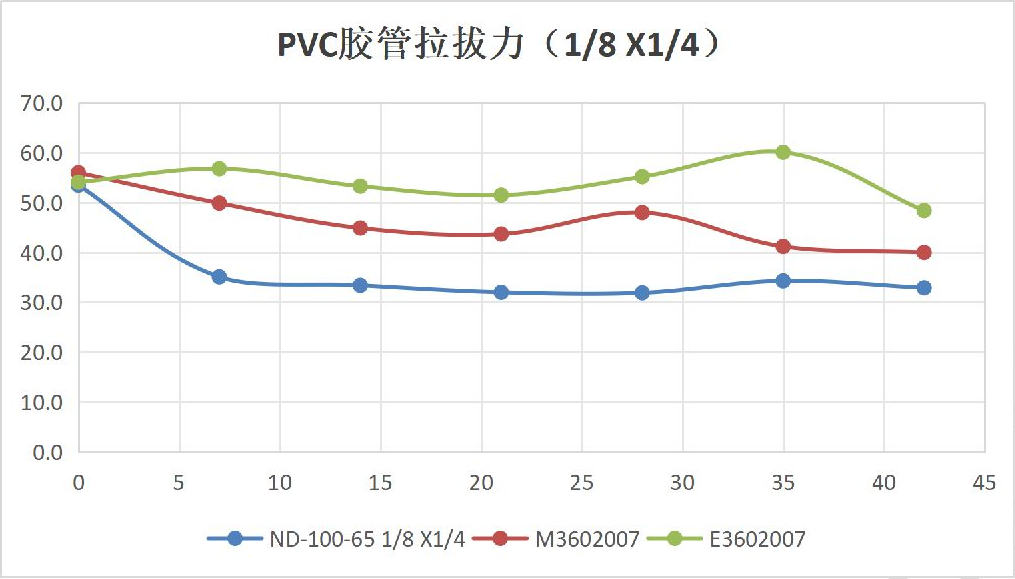
Pull-off testing used a different fitting set: SB-U28-16-PP-N for the smaller tubing and SB-U28-32-PP-N for the larger. After initial measurements, tubing was aged in a 70°C chamber, removed weekly, fitted to the appropriate barb and measured on a tensile tester through day 42. No supplementary fastener was used.
This measures tubing assembled after thermal aging. It is not aging of a continuously assembled, pressurized connection exposed to cleaner. Device working pressure and service life need device-specific validation; a 70°C, 42-day test alone cannot establish a year's operating life.
| Tubing / ID × OD, mm | Initial mean | Day 42 mean | Decrease from initial mean |
|---|---|---|---|
| TYGON ND-100-65/1.6×3.2 | 21.4 N | 16.0 N | About 25.2% |
| M3602002/1.6×3.2 | 27.2 N | 24.8 N | About 8.8% |
| E3602002/1.6×3.2 | 38.1 N | 34.6 N | About 9.2% |
| TYGON ND-100-65/3.2×6.4 | 53.5 N | 32.9 N | About 38.5% |
| M3602007/3.2×6.4 | 56.0 N | 40.0 N | About 28.6% |
| E3602007/3.2×6.4 | 54.1 N | 48.4 N | About 10.5% |
Decrease = (initial mean − day 42 mean) ÷ initial mean × 100%
Calculated from the rounded means in the table; descriptive comparison, not a service-life decay model.
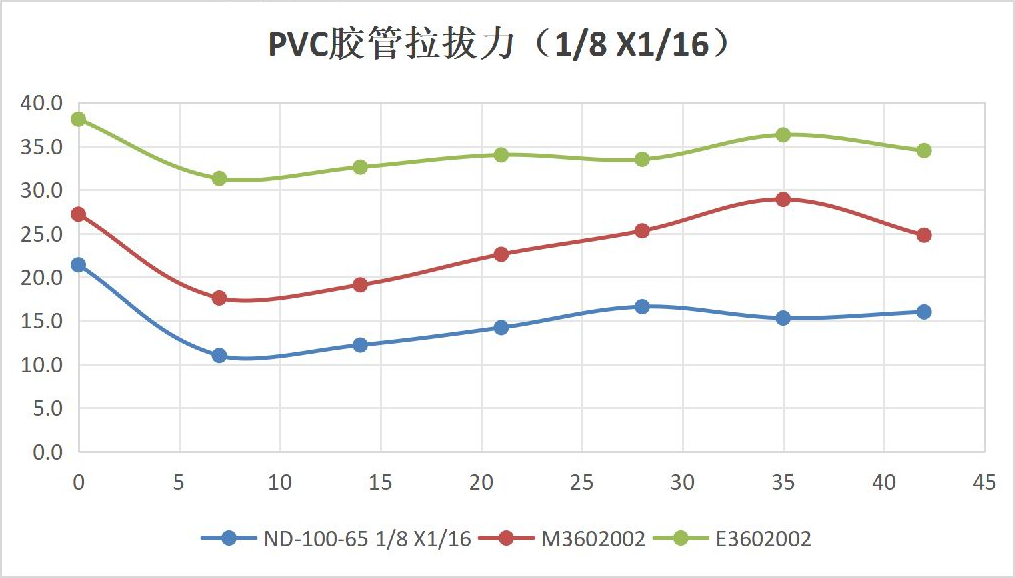
Intermediate points also matter. E3602002 averaged 31.3 N on day 7, below its day 42 value of 34.6 N. The smaller reference tubing averaged 11.0 N on day 7 and 16.0 N on day 42. Endpoints alone miss lower intermediate values. Review the full interval, individual variation and actual tensile loads when defining acceptance.
06Can barbed fitting pull-off force be converted into pressure? Axial load versus fluid pressure
Pressure and force have different units and loading methods. F = P × A can estimate axial force on an effective area in an ideal case. Real barb connections also involve tube expansion, contact distribution, bending, friction and assembly variation; effective area cannot automatically be taken from a nominal dimension. This calculation supports load analysis, not a replacement for hydrostatic assembly testing.
Passing a tube-burst test does not replace pull-off testing either. Assembly, lid opening, harness movement and consumable replacement can impose tension, even in a low-pressure line. Provide slack, support and sensible bend positions so the joint does not continually carry movement or maintenance loads.
The hydrostatic and pull-off tests here used different barb models. Their tables cannot be combined into a complete specification for one assembly. Align the final tubing, fitting and installation requirements in a single validation plan.
07How can IVD tubing pull-off be prevented? Validating the barb assembly and installed line
During development, screen material and connection samples, then test the actual assembly under the most demanding intended conditions. The sequence below helps separate material, fit, pressure and external-load issues and obtain comparable supplier samples.
- Fix the combination: tubing part number, ID/OD, tolerances, hardness, full fitting model, insertion depth, supplementary restraint and preassembly treatment.
- Record pressure conditions: normal operation, start/stop, valve switching and expected blockage; define peaks and cycles for validation.
- Include actual fluid and temperature: expose assemblies to the cleaner concentration, maximum temperature and idle cycle, then check sealing, pressure-hold and pull-off.
- Reproduce routing: bends, length, support points and maintenance tension; record whether failure is leakage, release or tube rupture.
- Define assembly acceptance: preserve individual results, sample count, lots and decision criteria before establishing the device's operating range.
FOREACH PVC tubing and barbed fittings can be evaluated as a matched combination. These tests explain methods and results for specified combinations. Revalidate the final delivered assembly after changing tubing, size, fitting or restraint. Product cards provide specifications, not project-specific assembly-validation evidence.
08What should be retested after changing PVC tubing or barbed fittings?
The same nominal ID does not ensure identical fit across tubing and fittings. After changing compound, hardness, tolerances, barb profile, insertion depth or restraint, recheck assembly, sealing, pressure-hold and pull-off on the new final combination.
When introducing the assembly into production, include the validated tubing, fitting, assembly method and operating conditions in the acceptance requirements. Preserve individual results and lot information. Reassess changes against the same combination rather than carrying forward one old tubing-pressure number.