
What Is PVC Tubing? Hardness, Dimensions and Fittings for Instrument Lines
Flexible PVC tubing for instruments is made from a polyvinyl chloride compound and commonly used for wash-fluid supply, aqueous-fluid transfer and drainage connections. Its flexibility aids routing inside equipment, while transparent configurations help users observe filling and bubbles.
PVC tubing can be cut to the required length and paired with barbed or other suitable fittings to form flexible connection assemblies for supply, washing or drainage. Hardness, ID and wall thickness jointly affect bending, fitting insertion and retention. Select them for the available routing space, fluid and fitting dimensions.
01What is flexible PVC tubing made of, and why does formulation affect its use?
PVC stands for polyvinyl chloride. Flexible PVC obtains its flexibility and processing behavior from its formulation. The plasticizer system and other additives affect hardness, fluid-contact behavior and operating temperature. The material name therefore identifies only the base polymer, not a specific tubing model.
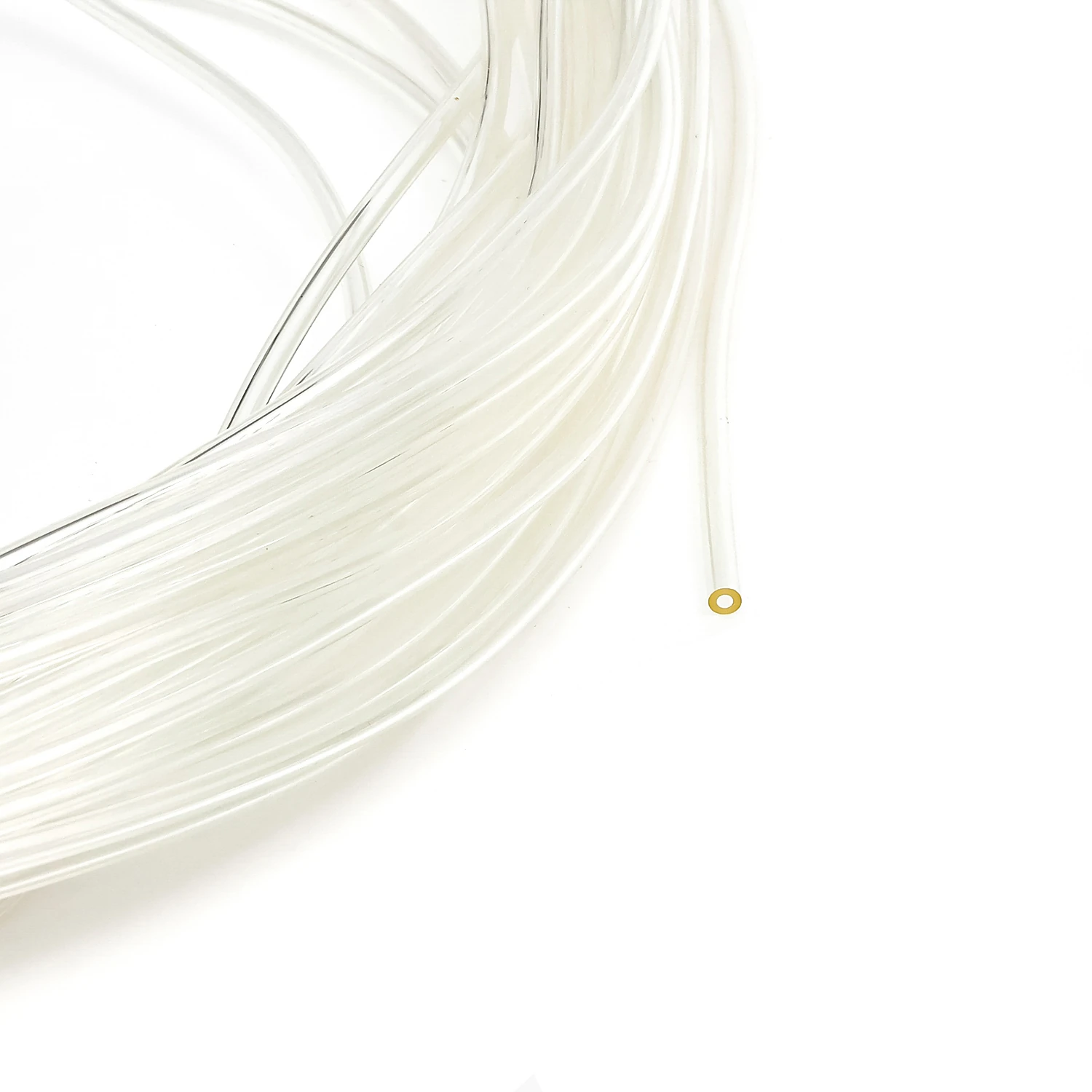
Transparent PVC tubing helps users observe filling, color changes and some bubbles, and can be routed through confined spaces. Assess transparency, bending and long-term appearance on the finished tube. Feel alone cannot establish pressure capability or chemical resistance.
DEHP-free and phthalate-free do not mean the same thing. The former addresses DEHP only and does not establish that every phthalate is excluded. For specified plasticizers or restricted substances, check the material declaration and test scope for the exact model.
02How do 55A and 65A hardness affect PVC tubing selection?
| No. | Item to check | Selection implications |
|---|---|---|
| 1 | Hardness | Affects insertion feel, bending and grip; compare together with dimensions and formulation |
| 2 | Wall thickness | Affects deformation, kinking and fitting compatibility; determined from both ID and OD |
| 3 | Routing bend radius | Tight bends reduce flow area; check the actual equipment routing |
| 4 | Temperature | Affects mechanical condition; check process fluid, cleaning fluid and internal equipment heating |
| 5 | Mode of use | Static connections, repeated movement and roller compression are different tasks requiring separate validation |
Softer tubing is easier to bend and push over fittings, but check vacuum collapse, deformation at clamps and fitting retention. Harder tubing also requires checks of insertion force and constriction at tight bends. Neither softer is always better nor harder always means greater pressure capability.
03How does PVC connection tubing differ from peristaltic pump tubing?
Connection tubing mainly provides fluid transfer, routing and sealing. Peristaltic pump tubing must also repeatedly compress and recover under rollers. Its formulation, ID, wall thickness, recovery and fatigue behavior must suit the pump head. Ordinary PVC connection tubing cannot be used in a pump head simply because the base material is the same.
- Connections before and after the pump: prioritize fluid compatibility, ID/OD, suction resistance, pressure and fitting sealing.
- Compressed section in the pump head: use dedicated tubing matched to the head, checking wall thickness, occlusion gap, speed and mode of use.
- Metering or long-term operation: record initial and post-run flow, recovery, wear and life, and establish replacement intervals from actual results.
If flow falls with operating time, distinguish pump-tube fatigue, connection-tube collapse, filter blockage and fitting air ingress. Increasing speed does not replace diagnosis, and an ordinary tube's hardness grade is not proof of pump-head suitability.
04Where is flexible PVC tubing used in instruments?
| Fluid-path location | Selection focus | Operating checks |
|---|---|---|
| Wash-fluid supply line | Match formulation to cleaning agent, concentration and temperature | Appearance, dimensions, connections and residue after cleaning |
| Aqueous-fluid connection | Select tubing and fittings for the specific fluid | Flow, bubbles, vacuum deformation and fluid visibility |
| Instrument drain line | Select material for all waste constituents and the discharge arrangement | Kinks, deposits, liquid elevation and blocked outlets |
| Connections requiring disassembly | Match tube ID and hardness to fitting-end geometry | Assembly damage, sealing and pull-out resistance |
Fluid compatibility still matters at the waste end of an instrument. Mixed waste contacts both tubing and fittings, often for extended periods. Assess all constituents, concentrations and cleaning methods rather than checking only one liquid.
Assess organic solvents, oils and concentrated cleaners individually; PVC formulations are not one uniform chemically resistant material. For assays sensitive to extractables, adsorption or particles, compare blanks and analyte recovery before and after contact. Chemical compatibility does not establish acceptable analytical background.
05How should PVC tubing ID, OD and length be selected?
ID affects flow and internal volume; ID and OD together determine wall thickness. Increasing OD at fixed ID thickens the wall and changes bending and insertion behavior. Specify ID × OD, not a single unspecified tube diameter.
Wall thickness t = (D − d) / 2; internal volume V = πd²L / 4
D: OD; d: ID; L: length. Flow-resistance estimates also require viscosity and flow. Use measured results if flexible tubing is significantly deformed or kinked.
For two tubes with a 1.6 mm ID, a 3.2 mm OD gives a 0.8 mm wall and a 4.8 mm OD gives a 1.6 mm wall. Their geometric volumes are equal at equal length, but deformation, bending space and fitting assembly differ, so they are not directly interchangeable.
- Select ID for target flow, viscosity and available differential pressure, then calculate filling and displacement volumes.
- Check OD and wall thickness for pressure, vacuum, bend radius and connection method.
- Determine length from equipment routing, avoiding sharp edges, pinch points and heat sources, and allow access for maintenance.
- Inspect tight bends, fixing points and suction sections during operation to confirm that the flow area is not significantly constricted.
06How should PVC tubing be matched to barbed fittings and quick disconnects?
Barbed fittings typically rely on elastic deformation as the tube is pushed over the barb. First check ID, then assess hardness, wall thickness, barb profile and insertion length. A fitting's stated compatible ID does not mean every tube of that ID has the same sealing and retention performance.
- Identify the connection: barbed ends generally match tube ID. For push-in fittings that grip OD, check OD, tolerance and any required support structure.
- Distinguish the quick-disconnect interface from the tube termination. The coupling mates and disconnects, while its tubing end may still be barbed; choose tubing for that end geometry.
- Control assembly: make a square, clean cut and insert fully as specified. Avoid scratches, excessive stretching and unqualified lubricants.
- Verify retention and sealing under working pressure, suction vacuum, temperature changes and tensile loading. Fit a clamp where the specific design requires one.
An oversized barb or forced insertion can damage the tube mouth and increase stress; a loose fit compromises sealing and pull-out resistance. Leave a straight section and support near the fitting so bending or maintenance loads do not continually act at the connection root.
07How are PVC tubing temperature, cleaning and service condition checked?
Determine operating temperature and pressure from the specific formulation, dimensions and fittings. Do not convert a hardness grade into a universal temperature limit or treat a short room-temperature test as long-term operating qualification. Record process and cleaning temperatures, internal heat sources and pressure peaks.
Cleaning or sterilization must cover tubing, fittings and seals. Before and after treatment, inspect color, transparency, hardness changes, dimensions, tackiness, cracks, sealing and analytical background. Arbitrary heating cannot restore aged tubing. Replace hardened, sticky, cracked or deformed sections according to maintenance requirements.
- At first installation, record model, batch, length, fittings and fluid, and establish repeatable assembly and acceptance conditions.
- During operation, inspect tight bends, clamps, vacuum sections and fitting roots, monitoring changes in flow, bubbles and leakage.
- After cleaning, recheck appearance, dimensions and sealing; repeat background and residue measurements for sensitive fluid paths.
- Set inspection and replacement intervals for the operating conditions. When replacing tubing, check formulation, hardness and dimensions rather than color alone.
08How is FOREACH PVC tubing selected by hardness and dimensions?
| Model | Hardness | ID × OD (mm) | Packaging |
|---|---|---|---|
| M3602002 | 55A | 1.6 × 3.2 | 30 m/roll |
| M3602003 | 55A | 1.6 × 4.8 | 30 m/roll |
| E3602001 | 65A | 0.8 × 2.4 | 30 m/roll |
| E3602S02 | 65A | 1 × 2.7 | 30 m/roll |
Keep the complete model, product code, hardness and pack unit in the BOM. When pairing tubing with barbed fittings, provide the fitting model or end drawing, fluid, temperature, pressure or vacuum, bend radius and disassembly requirements so tubing and connection conditions can be matched together.
10Flexible PVC tubing selection FAQ
1. Which parameters besides ID matter when matching PVC tubing to a barbed fitting?
Check tube OD, wall thickness, hardness and formulation, plus barb OD, profile and effective insertion length. These parameters can change deformation, contact and retention even at the same tube ID. Select for fluid, temperature, pressure or vacuum and routing loads. After assembly, inspect insertion depth, tube-mouth condition, sealing and pull-out resistance; insertion feel alone does not establish acceptance.