
How to Choose Fitting Materials: PP, PA, POM, PVDF and PEEK
Start fitting material selection with the properties of the material itself. PP has low density and resists many aqueous solutions; PA offers strength, toughness and wear resistance; POM combines stiffness, low friction and dimensional stability; PVDF offers chemical resistance; PEEK combines elevated-temperature performance, strength and chemical resistance. Evaluate the actual fluid, temperature, pressure and mechanical loading.
Compare explicit temperature and pressure values. Material reference upper limits are PP 110°C, PA 120°C, POM 100°C, PVDF 150°C and PEEK 225°C. In contrast, a Q20 fitting with PP body and EPDM seal has an upper operating temperature of 71°C and a listed working pressure of 120 psi (approximately 0.83 MPa). Material properties and complete-fitting requirements are discussed separately below.
Validate under actual operating conditions before service. Sealing and life depend on fluid identity/concentration, temperature, pressure and fluctuations, contact time, cleaning, seals, tubing and assembly. These values support initial selection, not replacement of actual tests. Before installation or production use, test the chosen model within its permitted conditions with the intended fluid, seals and tubing.
01How do PP, PA, POM, PVDF and PEEK fitting materials differ?
| Material | Material reference temperature range | Properties and application directions |
|---|---|---|
| PP | Polypropylene | −10–110°C | Low density; resists many aqueous solutions. Candidate for aqueous reagent and rinse lines after compatibility confirmation |
| PA | Polyamide / nylon | −40–120°C | Strength, toughness and wear resistance; candidate for mechanically loaded connections, considering dimensional change after water absorption |
| POM | Polyoxymethylene / acetal | −40–100°C | Stiffness, low friction and low water absorption; candidate for repeatedly connected or sliding components |
| PVDF | Polyvinylidene fluoride | −40–150°C | Chemical resistance with mechanical strength; candidate for corrosive reagent and chemical-sample lines |
| PEEK | Polyetheretherketone | −180–225°C | Elevated-temperature capability and strength; candidate for higher-temperature or load-bearing requirements |
Lower limits are also material reference values, not proof of reliable fitting sealing at that temperature. For cold service, test body, seals and tubing together.
PP: low density and suitability for many aqueous fluid paths
PP resists many salt solutions, alkalis and weak acids. PP barbed or thread-to-barb fittings can be candidates for aqueous reagents, rinsing and reservoir-to-tubing connections, subject to compatibility with the actual fluid.
Focus on fluid identity and sustained loading. Oxidizing cleaners, some organic solvents and elevated temperatures require separate assessment. Tube tension or thread compression can cause deformation affecting fit and sealing. Successful ambient-water service does not establish suitability after hot cleaning.
PA: strength, toughness and wear resistance
PA can be considered for assembly loads, tubing tension or repeated friction because of its mechanical properties. Still provide proper tubing support to reduce external loads on the fitting.
PA absorbs moisture from air and may absorb water from aqueous media, changing dimensions and mechanical properties. This can affect thread engagement and barb retention. PA6, PA66 and PA12 are distinct polyamides; 'nylon' does not make them interchangeable.
Even one polyamide type has different resin grades. A grade identifies a material supplier's formulation/product, not the fitting model. Confirm grade, reinforcement or modification, then test dimensional and property changes after moisture absorption and actual-fluid exposure.
POM: stiffness, low friction and dimensional stability
POM's stiffness, wear resistance, low friction and low water absorption help maintain dimensions and clearances. Consider it for quick disconnect or sliding components, while checking actual wetted fluids and loads.
Mechanical properties do not replace compatibility testing. Assess strong acids, strong oxidizers and chlorine-containing cleaners particularly carefully. Smooth dry operation does not prove retained fit or sealing after immersion or repeated cleaning.
PVDF: chemical resistance with mechanical strength
PVDF is a fluoropolymer resistant to many acids, salts and other chemicals. It is a candidate for corrosive reagents or chemical samples; also confirm that the required configuration and size are available.
PVDF has limitations, notably with strong alkalis and particular organic solvents. Assess concentration, temperature and resin formulation. 'Fluoropolymer' does not mean compatible with every corrosive medium.
PEEK: elevated-temperature performance and strength
PEEK combines temperature capability, mechanical strength and chemical resistance. Consider PEEK fittings and mating parts for rigid tubing in analytical instruments or locations requiring higher temperature capability, strength and dimensional stability.
PEEK is not universal: concentrated sulfuric acid and strong oxidizers need particular scrutiny. Resin temperature capability does not establish a finished fitting's operating temperature or pressure rating. Threads, wall thickness, port structure and tubing must all suit the duty.
A 121°C cleaning requirement exceeds the table's PP 110°C, PA 120°C and POM 100°C reference limits. PVDF 150°C and PEEK 225°C exceed 121°C, but still require confirmation of finished-fitting temperature limits, cleaning fluid and duration. Passing initial material screening is not validation for 121°C cleaning or sterilization.
02Why must O-ring material be selected separately from the fitting body?
After the body, examine the sealing structure. Some fittings use O-rings, gaskets or other seals. An O-ring quick disconnect closes the mating gap through seal compression; a one-piece barb mainly relies on the tube wall conforming to its surface. Not every fitting requires an added O-ring.
Body and seal have different functions and may use different materials. For a PP body with EPDM (ethylene propylene diene rubber), confirm both against the same fluid and cleaning conditions. Seal swelling, hardening or insufficient elastic recovery after compression can cause leakage or difficult connection even if the body looks intact.
| Series and material combination | Operating temperature | Difference from body-material reference |
|---|---|---|
| Q20 / Q40 | PP body + EPDM seal | −20–71°C | Finished fitting upper limit 71°C, not the PP reference limit of 110°C |
| Q20 / Q40 | POM body + NBR seal | −40–82°C | Finished fitting upper limit 82°C, not the POM reference limit of 100°C |
Cleaning at 80°C exceeds the 71°C limit for Q20/Q40 PP+EPDM. POM+NBR has an 82°C upper limit, but cleaning chemistry, temperature variation and pressure still need confirmation. Changing to FKM fluoroelastomer seals requires reassessment of the complete fitting's permitted temperature and pressure; do not copy the old combination or a rubber-material table.
| Connection structure | Check beyond the body | Material-selection implication |
|---|---|---|
| One-piece barbed fitting | Tubing inner wall, dimensions and hardness | Fluid-induced tubing changes can affect sealing and pull-off resistance |
| Thread-to-barb fitting | Tubing and any gasket or auxiliary sealing material actually used by the model | Check the real thread-end seal; do not assume every model uses an O-ring |
| Quick disconnect with O-ring | O-ring and, in valved models, internal wetted valve parts | Confirm body, seal and internal wetted parts separately |
| Rigid-tube connection assembly | Tubing and mating parts that contact fluid or participate in sealing | Confirm material, port and component matching; appearance alone does not establish compatibility |
PTFE, ETFE and PFA can also be used in tubing, seals or other connection parts according to duty. PTFE thread tape, for example, is an auxiliary sealant for some threaded joints; using it does not mean the fitting body is PTFE.
For valved quick disconnects, see Quick disconnect materials and operating conditions; For rigid tubing, see Rigid-tube fitting construction and matching.
03How do you assess compatibility with reagents and cleaning fluids?
List every fluid: process liquid, cleaner, disinfectant, rinse and mixtures remaining during shutdown. 'Acid', 'alkali' or 'alcohol' is insufficient. Concentration, temperature and contact time can change the conclusion for the same chemical.
- Record chemical identity and concentration; for mixtures, state major components and proportions using the actual formulation or product data.
- List operating and cleaning temperature, contact time, frequency and any prolonged shutdown immersion separately.
- Use compatibility information for initial screening, then confirm the resin, actual components and complete assembly. Missing compatibility data is not approval.
- Validate actual samples for mixtures, changing temperatures or sustained loads, including seals and tubing.
A line carrying ambient aqueous liquid and periodically cleaned with a chlorine-containing agent cannot be assessed for water alone. Record the cleaner's active ingredients, concentration, temperature and contact time, then check body, seal and tubing. Repeated cleaning may change these parts and cause a previously sound joint to leak.
Use the site's Material compatibility lookup for initial screening, then test the actual resin, concentration and operating conditions.
Compatibility must cover samples, reagents and cleaners. These application guides help identify analytical and field-monitoring fluid, cleaning and maintenance conditions.
04What pressure can fittings withstand, and how do quick disconnects compare with dedicated high-pressure fittings?
| Product and material combination | Pressure parameter | Scope |
|---|---|---|
| Q20 / Q40|PP+EPDM | Working pressure 120 psi ≈ 0.83 MPa (8.3 bar) | Temperature range −20 to 71°C; confirm allowable pressure at the target temperature |
| Q20 / Q40|POM+NBR | Working pressure 120 psi ≈ 0.83 MPa (8.3 bar) | Temperature range −40 to 82°C; confirm allowable pressure at the target temperature |
| Q60|PP+EPDM | Working pressure 60 psi ≈ 0.41 MPa | For the listed Q60 fittings; do not apply Q20/Q40's 120 psi |
| Dedicated high-pressure fitting family | 10-32 UNF coned port | Family maximum pressure 34 MPa (340 bar) | Limit of that dedicated family, not every PEEK or rigid-tube fitting |
MPa values are rounded conversions from psi. Evaluate pressure and temperature together; do not assume maximum pressure is permitted at maximum temperature. Confirm each model's pressure at the target temperature, then test with actual fluid, seals and tubing, including start/stop transients, cleaning and sustained operation. For cold Q60 service, confirm the lower temperature limit of the exact mating models.
At a required 0.60 MPa, Q60's 60 psi (approximately 0.41 MPa) is insufficient despite its larger bore. Q20/Q40's 120 psi (approximately 0.83 MPa) exceeds 0.60 MPa, but suitability still depends on flow, temperature, fluid and peak pressure. For dedicated high-pressure fittings, match model, tubing and port; 34 MPa is not a generic PEEK rating.
Installation torque also depends on the high-pressure fitting material
For that dedicated high-pressure structure, listed assembly torques are 0.45 N·m for PEEK and 2.2 N·m for metal. Confirm the exact model; do not apply these values to ordinary barbs or other ferrule fittings. Additional tightening cannot increase the pressure rating.
| Equipment condition | Required check |
|---|---|
| Pressurized operation at elevated temperature | Allowable pressure of fitting and tubing at the target temperature |
| Cyclic starts/stops or cleaning | Leakage or loosening after repeated temperature/pressure changes and alternating fluids |
| Threaded assembly | Torque, tool and sealing method for the material and structure |
| Barb-to-tubing connection | Tubing dimensions, hardness, expansion during insertion and restraint |
For threaded joints, see Thread-to-barb installation and torque scope; For tubing connections, check Barb expansion and tubing-fit validation.
05How should equal-size PP and PA barbed fittings be compared?
FOREACH BA-32F-PP-N and BA-32F-PA-W are straight F-profile barbs for 3.2 mm ID tubing. PP-N means natural PP; PA-W means white PA. Use the same tubing specification and connection method when assessing suitability for the actual fluid and duty.
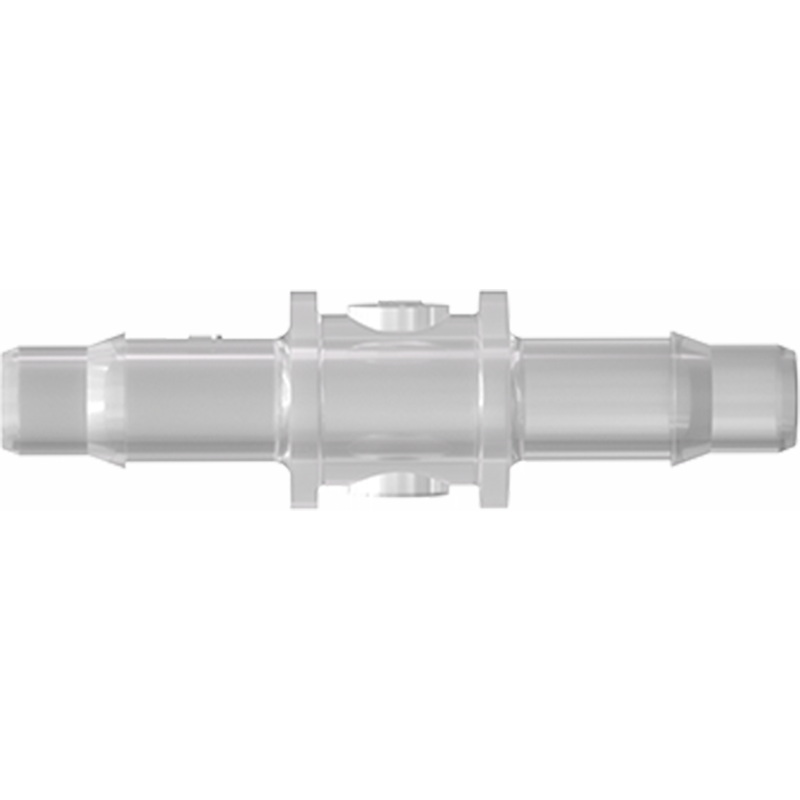
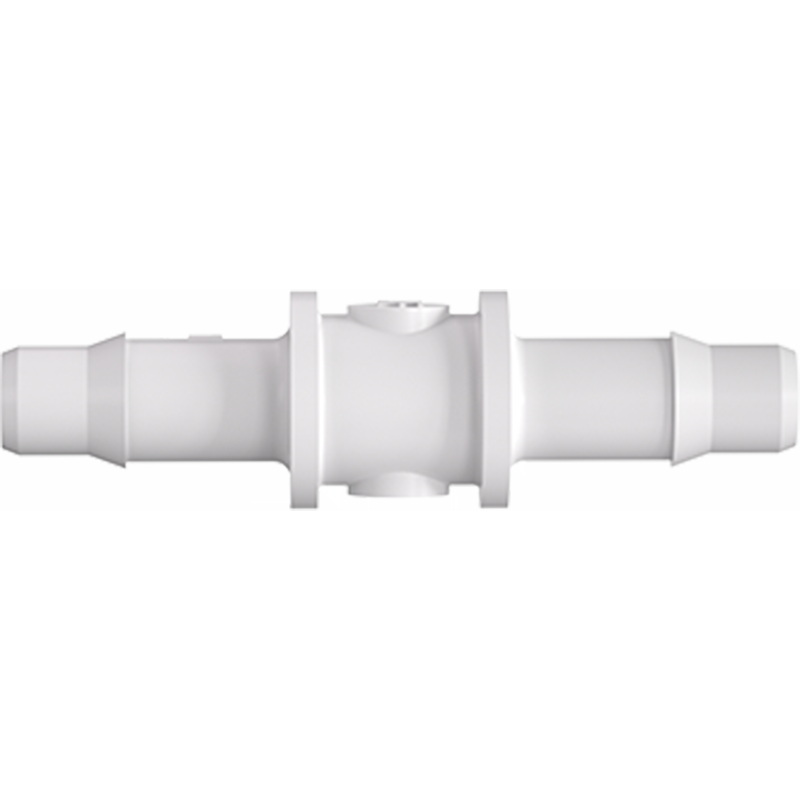
To join two 3.2 mm ID tubes, first check PP compatibility with fluid and cleaner. If considering PA for mechanical strength, test moisture-induced dimensional and property changes rather than judging dry assembly alone. Without defined fluids and duty, neither model can be declared the better choice.
Use the same tubing batch, assembly method and test conditions. Inspect tube damage, leakage, pull-off resistance and changes after service. Natural and white identify models, not quality grades. A material change requires renewed fit and sealing tests even when the shape is unchanged.
For straight, elbow or branch selection, return to Barbed fitting structures, models and mating requirements.
06How should fittings be tested under actual conditions before service?
Test the intended purchased model with its actual seals, tubing and mating parts using real fluid, temperature, pressure and cleaning. Identical material names can conceal different formulations, dimensions or assembly. Test the complete fitting and tubing combination.
- Preparation: record complete model, drawing revision, body/seal materials, tubing and assembly; define test conditions and acceptance criteria for the duty.
- Fluid exposure: use actual formulation, concentration, temperature and time; inspect appearance, dimensions and properties. For analytical circuits, assess extractables or fluid residues that could interfere with measurement as required by the project.
- Connection tests: assemble actual flexible or rigid tubing and mating parts as specified; check leakage, pull-off resistance and flow at intended temperature/pressure, adding repeated disconnection if required.
- After operation: simulate starts/stops, continuous duty and cleaning within model limits; recheck sealing, loosening and deformation. Record batch, duration and results.
Define duration, cycles and acceptance criteria beforehand. A brief leak test does not establish long-term service life. Changes to body material, seals, tubing, assembly or cleaning require reassessment and relevant tests before use.
07Fitting material FAQs
What is the pressure rating of PA, PVDF or ordinary PEEK fittings?
Material name alone cannot establish it. Q20/Q40 120 psi, Q60 60 psi and the dedicated high-pressure family's 34 MPa apply to their specific products or family. Confirm the chosen model and tubing ratings and validate actual conditions before service.
Can a fitting specified only as PA be purchased as PA66?
No. PA is the polyamide family, not a specific PA6, PA66 or other type. Confirm resin grade, reinforcement and modifications with the supplier and state them in purchasing requirements. Moisture absorption and mechanical properties may differ.
Can a plastic fitting simply be replaced with stainless steel?
Recheck the complete connection: steel grade, surface, fluid compatibility, threads, sealing faces, tubing fit and installation. Matching names or appearance do not establish interchangeability, and plastic-fitting torque must not be reused automatically.