
Why Do Brushed Diaphragm Pumps Last Around 3,000 Hours and Brushless Pumps Around 10,000 Hours?
Brushed miniature diaphragm pumps commonly have a reference life of approximately 3,000 hours; brushless versions are often rated around 10,000 hours. The difference reflects commutation, dominant wear mechanisms and the actual duty profile rather than a simple motor-quality ranking.
Miniature diaphragm pump specifications often distinguish a brushed motor life of around 3,000 hours from a brushless motor life of around 10,000 hours. Engineers naturally ask why changing the drive motor can produce such different reference lives in an otherwise similar pump.
The answer is not that brushless is automatically better or brushed is inherently unreliable. The two drive architectures use different commutation methods, so different components reach their practical service-life limits first.
Brushed motors depend on continuous contact between brushes and a commutator. Brushless motors replace that mechanical interface with electronic commutation, shifting attention toward bearing wear, temperature rise, drive electronics and the actual pump load.
1. What do 3,000 and 10,000 operating hours actually mean?
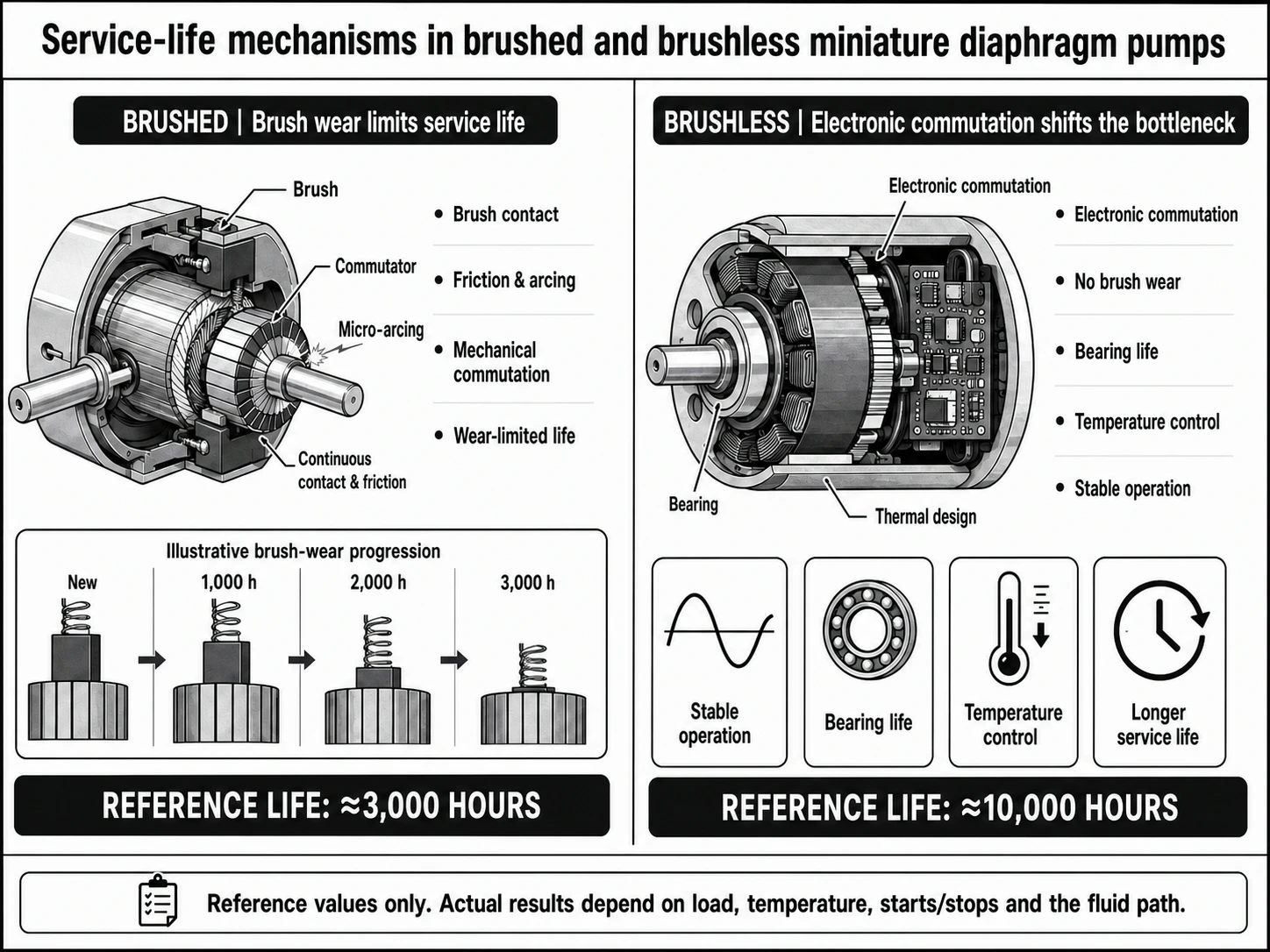
Neither value is a guaranteed failure time. Both are engineering reference lives established under specified operating conditions and intended to help compare applications and maintenance expectations.
Actual life changes with hydraulic load, outlet pressure, start-stop frequency, ambient temperature, continuous operating time, fluid-path resistance, chemical compatibility and installation.
2. The fundamental difference: mechanical versus electronic commutation
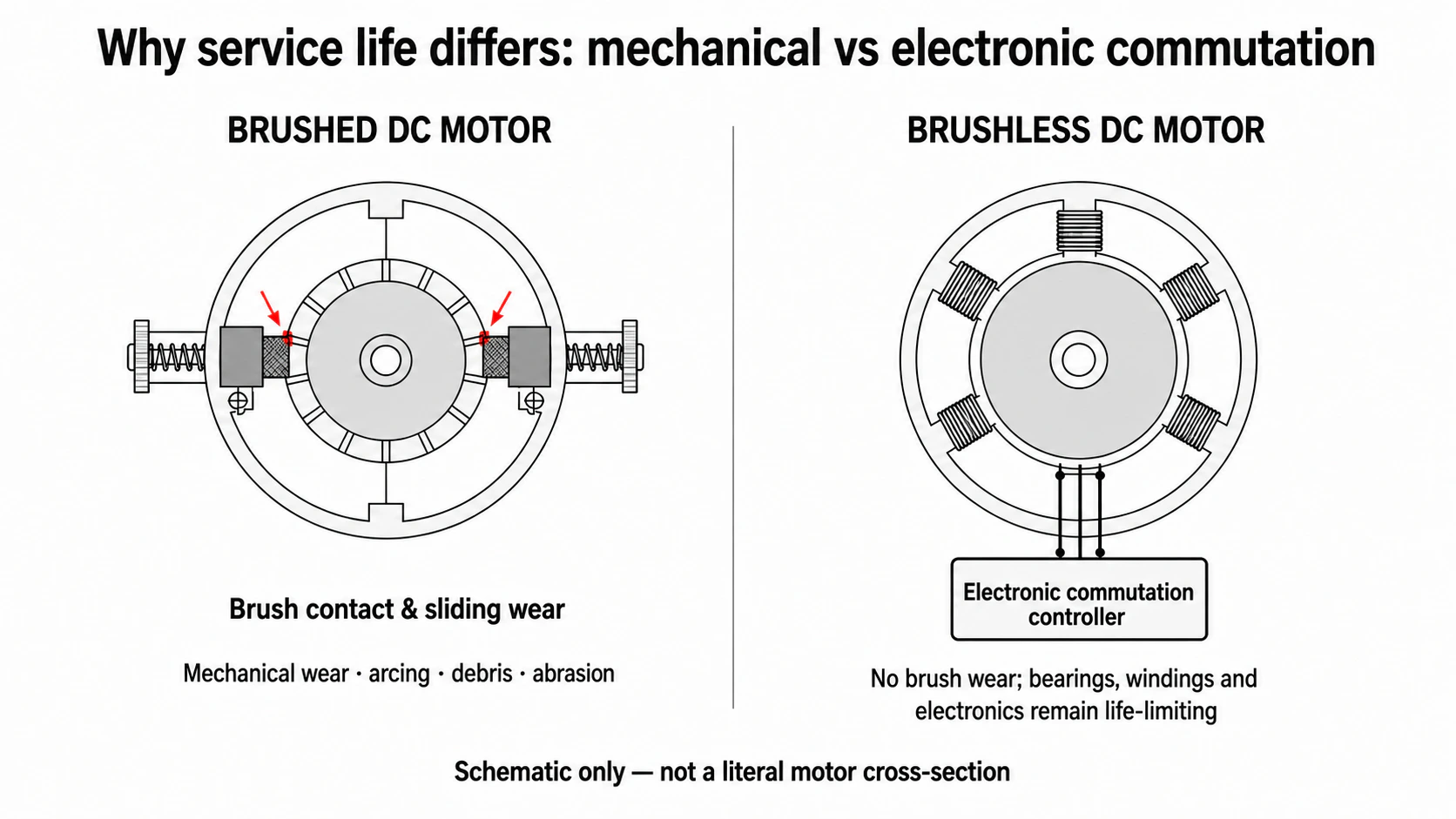
A brushed DC motor switches current through brushes sliding against a mechanical commutator. A brushless DC motor performs commutation through an electronic controller. This structural distinction determines which wear mechanism dominates long-term operation.
3. Why is a brushed configuration commonly rated around 3,000 hours?
The brush and commutator form the critical contact pair inside a brushed motor. As long as the rotor turns, the brush presses against the commutator surface and carries switching current.
The main service-life mechanisms are:
- Continuous sliding contact progressively wears both brush and commutator surfaces.
- Small commutation arcs and localized heating can accelerate material loss.
- Brush length decreases with cumulative operating time, eventually degrading electrical contact.
- Once wear becomes significant, performance may decline and the brush or motor may require replacement.
Therefore, brush-commutator wear can reach its practical limit before other components, explaining the approximately 3,000-hour reference class often associated with brushed miniature diaphragm pumps.
4. Why is a brushless configuration commonly rated around 10,000 hours?
A brushless motor removes the brush and mechanical commutator and uses electronic switching instead, eliminating the most characteristic sliding-contact wear mechanism.
Brushless does not mean unlimited life. Bearings, lubricant condition, controller reliability, winding temperature and hydraulic load still constrain operating life.
Because no brush gradually wears against a commutator, brushless drives are often better suited to continuous or high-utilization applications and commonly reach a reference class around 10,000 hours.
5. Motor life is not the same as complete pump life
A miniature diaphragm pump also contains an eccentric drive, connecting mechanism, diaphragm, check valves, pump head and sealing components. Complete pump life depends on all of these elements, not on the motor alone.
Even a brushless drive cannot compensate for incompatible fluid-contact materials, diaphragm swelling, valve degradation or continuous operation against excessive back pressure.
6. Which operating conditions change the actual service life?
- High hydraulic load and outlet pressure increase motor and transmission stress.
- Frequent starts and stops change mechanical loading and thermal cycling.
- Elevated ambient temperature affects windings, bearings, lubricants and diaphragm materials.
- Restrictive tubing, fittings, valves or filters can shift the pump away from its intended operating point.
- Incompatible liquids may accelerate swelling, hardening, corrosion or loss of sealing performance.
7. When should you choose brushed or brushless?
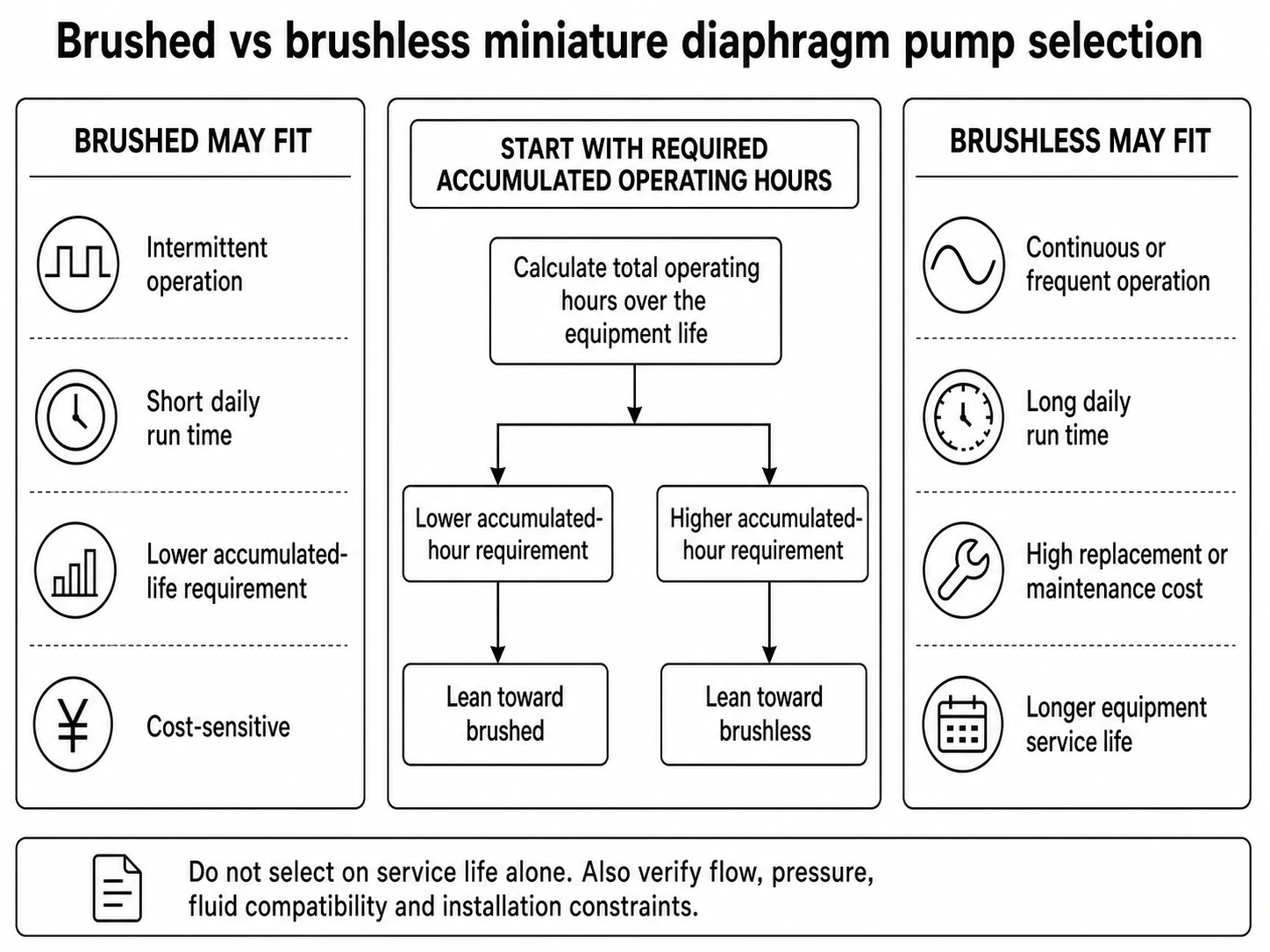
Motor selection should begin with the total operating hours the instrument requires during its expected service life—not just the numbers 3,000 and 10,000.
A brushed drive may be suitable for intermittent operation, limited daily running time, accessible maintenance and cost-sensitive projects.
A brushless drive is generally preferable when utilization is high, continuous operation is required, pump replacement is difficult or maintenance downtime is expensive.
| Selection factor | Brushed drive | Brushless drive |
|---|---|---|
| Reference life | Approximately 3,000 hours | Approximately 10,000 hours |
| Duty profile | Intermittent operation and shorter daily runtime | Continuous operation or frequent use |
| Accumulated hours | Lower lifetime operating-hour requirement | Higher lifetime operating-hour requirement |
| Maintenance and cost | Cost-sensitive design with accessible servicing | High replacement cost or longer maintenance interval |
8. A practical first calculation: accumulated operating hours
At the beginning of a project, estimate the required operating time with a simple duty-profile calculation:
Daily operating hours × operating days per year × target equipment lifetime in years = required accumulated operating hoursIf the required accumulated time is modest, a brushed configuration may be technically and economically adequate. As operating time or maintenance cost increases, the value of a brushless drive becomes more evident.
The useful question is not simply which number is larger, but which drive architecture fits the instrument's actual lifecycle and hydraulic operating conditions.
For a more detailed discussion of continuous duty and pump durability, read:How long can a miniature diaphragm pump run continuously?.
Conclusion: reference life becomes meaningful only in the real application
The common distinction between approximately 3,000 brushed hours and 10,000 brushless hours results from commutation architecture, the dominant wear mechanism and typical operating conditions.
A sound selection combines cumulative operating hours, actual fluid-path loading, chemical compatibility and maintenance economics. Reference life is useful only when interpreted within that complete engineering context.
FAQ: brushed versus brushless diaphragm pump service life
Will a brushed motor always fail after 3,000 hours?
No. Around 3,000 hours is a reference value under specified conditions. Actual life depends on load, pressure, switching frequency, temperature and the complete fluid path.
Must a brushless motor be replaced after 10,000 hours?
Not necessarily. Around 10,000 hours is not a fixed replacement deadline; bearings, temperature rise, controller condition and application loading determine the practical limit.
Does a brushless motor have no wear?
No. It avoids brush-to-commutator contact wear, but bearings, lubricant, controller electronics and other moving pump components still have finite service lives.
Are brushed pumps unsuitable for long-term equipment use?
Not automatically. When daily runtime and accumulated lifetime hours are limited, a brushed pump can remain a practical and economical choice.
What else matters when selecting a miniature diaphragm pump?
Evaluate effective flow, operating pressure, self-priming, fluid compatibility, installation space, electrical supply, duty profile and maintenance accessibility.