Foreach TechnologyForeach Technology
Home
Products
Applications
About Us
Contact & Partnership
简体中文EnglishEspañolFrançais한국어Русский
Home
Products
Pump SeriesValve SeriesTubing SeriesFitting SeriesProbe SeriesSmart Control SeriesTubing Assemblies
Applications
All applicationsIVD DiagnosticsLife SciencesLaboratory AutomationAnalytical InstrumentsEnvironmental MonitoringSynthetic Biology
Resources
DatasheetsFluid Resistance CalculatorFitting ReplacementInstallation GuidesMaterial CompatibilityTechnical ArticlesCompany News
About Us
About ForeachR&D and ManufacturingQuality System and QualificationsMilestonesForeach Culture
Contact & Partnership
Contact UsBecome a Distributor
  • Pump Series
  • Valve Series
  • Probe Series
  • Fitting Series
  • Tubing Series
  • Control Series
  • Tubing Assemblies
  • All applications
  • IVD
  • Life Science
  • Lab Automation
  • Analytical Instruments
  • Environmental Monitoring
  • Synthetic Biology
  • Datasheets
  • Fluid Resistance Calculator
  • Fitting Replacement
  • Installation Guides
  • Material Compatibility
  • Technical Articles
  • Company News
  • About Foreach
  • R&D & Manufacturing
  • Quality & Compliance
  • History
  • Foreach Culture
  • Inquiry Form
  • Contact Information

Shenzhen Foreach Technology Co., Ltd.

Address: 13th Floor, 2nd Building, Yufengda Industrial Park, 1008th Guang Qiao Boulevard, Guangming District, Shenzhen 518132 CHINAView Map

Email: [email protected]

Tel: +86 755 8655 3831

LinkedInYouTubeFacebookInstagramX

© 2026 Shenzhen Foreach Technology Co., Ltd. All rights reserved.

Privacy Policy·

Home/Applications/In Vitro Diagnostics/Clinical chemistry analyzer
< Back

Multiport rotary valves in clinical chemistry analyzers

Application guide

A clinical chemistry source-selection valve must connect the intended sample, reagent or wash path while the metering unit is in the correct state. Select the port arrangement around the real transfer sequence, then account for the old liquid remaining between the selected port and the probe.

Application guide

Clinical chemistry analyzer

Clinical chemistry analyzer
Diaphragm pumps in clinical chemistry analyzers
Probe/cuvette wash supply and waste removal
Bubble and pressure detection in clinical chemistry analyzers
Tubing and fittings in clinical chemistry analyzers
Multiport rotary valves in clinical chemistry analyzers
Sample, reagent and wash-path switching
Piston pumps in clinical chemistry analyzers
Metered reagent dispensingSample aspiration and transfer
Sampling and wash probes in clinical chemistry analyzers
Syringe pumps in clinical chemistry analyzers

On this page

What do these products do in this instrument?Choose ports from source and destination statesTrade shared plumbing against changeover liquid and timeTranslate actual branch conditions into configuration requirementsCompare product configurations by the roles on this pageExplore specific operating and validation tasksConfirm product roles in actual operationWhen should two reagent sources use separate paths instead of one selector?ReferencesRelated guides

01What do these products do in this instrument?

Multiport rotary valves: sample, reagent and wash-fluid source selection

Use multiport selection where several liquid sources or destinations must connect to the metering branch. Define which routes may share wetted sections and where old liquid is discharged before a new sample or reagent is delivered to a cuvette.

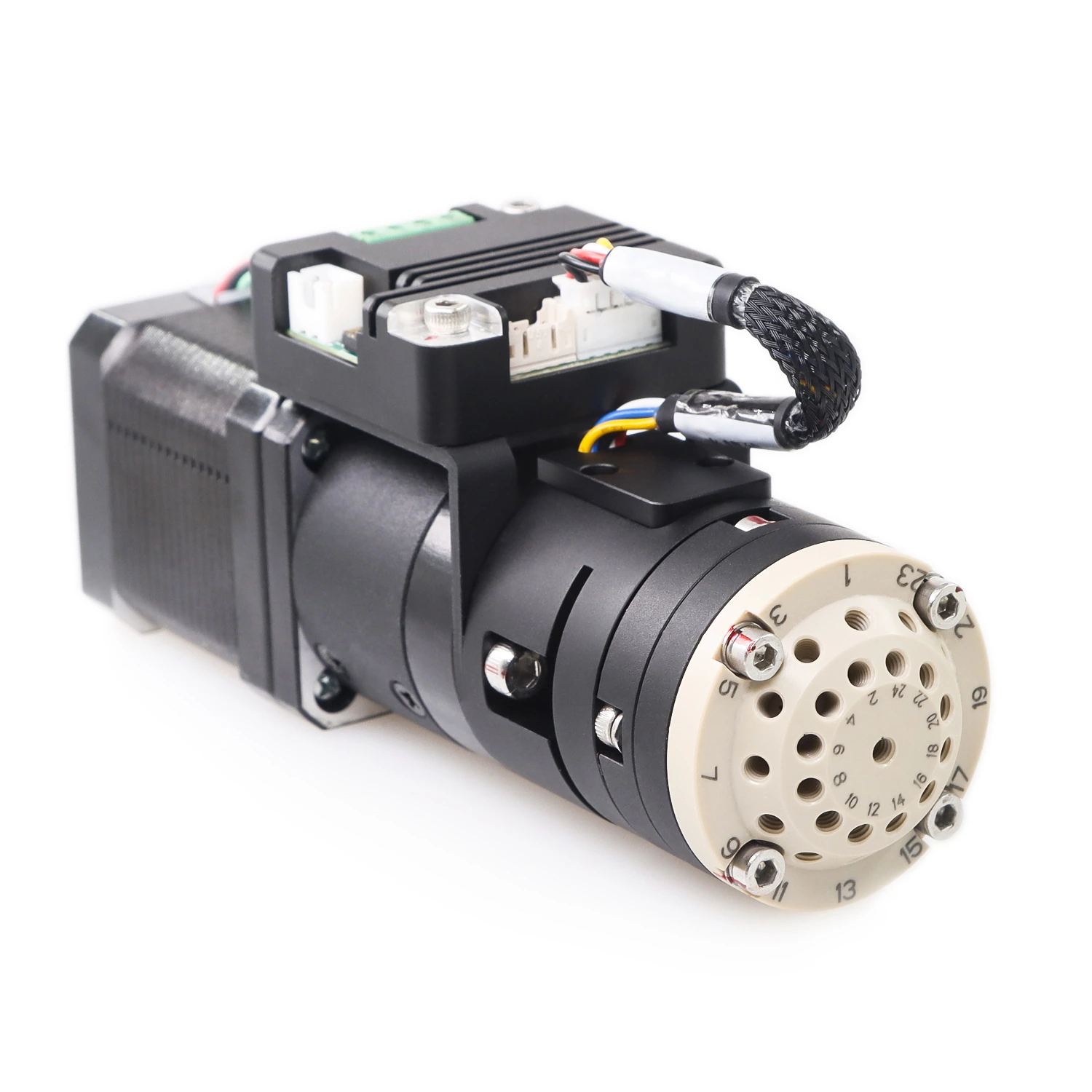
MRV3 selects sources or destinations and requires a port-state diagram and shared-volume budget. Port count indicates routing options; confirm pressure in each state and independent simultaneous supply requirements separately.

02Choose ports from source and destination states

List the required sample, reagent, wash and maintenance connections, including the state needed while the pump aspirates or dispenses. A selectable source is not an independent simultaneous supply path. If two tasks must run together, determine whether the proposed internal connection structure and shared metering branch permit that schedule before choosing a port count.

Further technical reading

  • Rotary Valve Selection Guide: From Fluid Paths to System Validation
  • Choosing Rotary Valve Wetted Materials: Head, Rotor and Seals

03Trade shared plumbing against changeover liquid and time

A shared valve-to-probe segment reduces separate tubing but retains the previous liquid after source selection. Establish which switching combinations matter to the assay and where their displacement or cleaning liquid will go. If the permitted sequence cannot clear a shared segment before the next dose, reconsider the route or use a dedicated path rather than assuming another valve command solves the residue.

04Translate actual branch conditions into configuration requirements

Multiport rotary-valve configuration conditions in clinical chemistry analyzers
ConditionTo confirm
Operating statesMap source, destination, metering action and permitted pressure for sampling, reagent addition and cleaning, including maintenance positions.
Shared-section budgetIdentify the retained segment and discharge destination for each relevant change of liquid, with its required renewal and time allowance.
Concurrent tasksCompare requested simultaneous operations with the real port connections and shared resources; include shutoff leakage and power-loss handling.
Operations supported in this instrument
OperationSpecific operating conditions
Sample, reagent and wash-path switchingSample/reagent/wash port map, metering sequence, shared-path volume, intended displacement destination, state pressures and tasks requested at the same time

05Compare product configurations by the roles on this page

Configuration options for the product roles on this page
ProductConfiguration optionConditions to verify
MRV3 multiport rotary valveMultiple-source selectionCompare 10-, 16- and 24-port options and port diagrams; verify high-pressure suitability separately
  • MRV3 multiport rotary valve

    MRV3 multiport rotary valve

    View Details

06Explore specific operating and validation tasks

Sample, reagent and wash-path switching

A port-state table should include pump actions, receiving containers and permissible pressure. Shared residue remains after the valve reaches position; the next liquid and assay residue requirements determine whether and how much to flush.

  • Sample, reagent and wash-path switching

07Confirm product roles in actual operation

Operating-point validation and fault localization
OperationMeasurements and observationsPriority checks
Sample, reagent and wash-path switchingExercise the intended source changes with the actual metering sequence. Verify the selected connection, new-liquid arrival and residue at the receiver, including the first dose after washing or replenishment.A confirmed valve position may still leave old liquid downstream. Investigate unintended connections, leakage and incomplete renewal before changing the metered amount.

Choose the valve configuration from the required connection states and accepted changeover sequence. Validate liquid delivery at the cuvette after switching, while the linked task page defines the detailed operating procedure.

08When should two reagent sources use separate paths instead of one selector?

Consider separation when the assay cannot tolerate their shared residue, the available changeover liquid or time is inadequate, or the tasks require independent simultaneous supply. Compare those constraints with the actual valve and drive connections rather than port count alone.

The assay determines sample suitability; full-scale metering specifications cannot replace small-dose and complete-instrument results.

References

View references (1)
  1. [1]FOREACH MRV3 multiport rotary valve: configurations and specifications

Related guides

  • Back to the clinical chemistry analyzer fluidics overview
  • Sample, reagent and wash-path switching

Related Products

MRV3 Rotary valves

MRV3 Rotary valves

Related Technical Articles

Rotary Valve Selection Guide: From Fluid Paths to System Validation

Map the connections required at each step before comparing specifications. Use the actual liquids, tubing and switching sequence to validate suitability for your instrument.

2026-09-30View Details

Choosing Rotary Valve Wetted Materials: Head, Rotor and Seals

Identify every component in contact with liquid before comparing PEEK, PCTFE and other candidates. Evaluate chemical compatibility, dynamic sealing and analytical results together.

2026-09-30View Details

Discuss Your IVD Fluidic Requirements

Share the instrument type, sample and reagent properties, working volumes, cycle timing, fluid path and acceptance criteria so we can discuss suitable components and prototype evaluation.

Discuss your application