
What do these products do in this instrument?
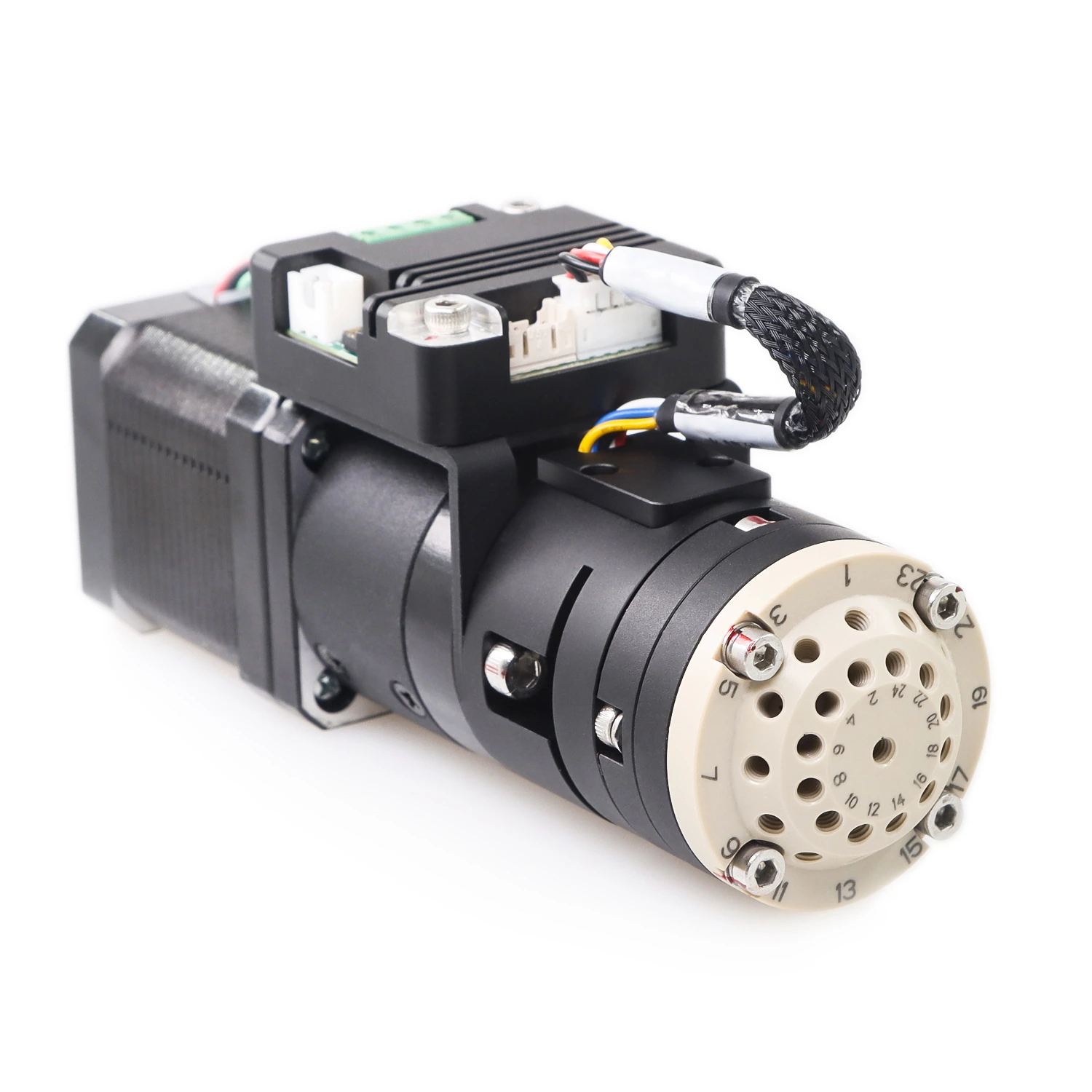
Multiport rotary valves: reagent, nucleic-acid eluate and maintenance-destination selection
Route sources and receivers where the workstation uses fixed fluidics. Separate product collection from wash and maintenance discharge, and coordinate the selected route with the material retained at each extraction step. Magnetic-rod or disposable-tip actions still require their own handling controls.
MRV3 selects sources or destinations and requires a port-state diagram and shared-volume budget. Port count indicates routing options; confirm pressure in each state and independent simultaneous supply requirements separately.
Select ports by material destination and contamination zone
Map lysis and binding reagents, wash liquids, eluate receivers and waste only where they connect through the valve. A common selector can reduce separate plumbing but introduces shared wetted surfaces and state-dependent routes. If product and waste cannot be kept appropriately separated through operation and service, use a different routing arrangement rather than relying on the next commanded position.
Further technical reading
Verify every transition that can affect recovered product
Consider reagent-to-wash and wash-to-elution changes together with the liquid retained downstream. Direct renewal liquid to its intended discard destination before product collection begins. Include maintenance and power-loss states in the review, since an unintended connection or backflow at those times can affect a later extraction even when routine selection works.
Translate actual branch conditions into configuration requirements
| Condition | To confirm |
|---|---|
| Source and receiver map | Identify the fixed reagent, sample or eluate paths, corresponding wells/receivers and the material retained or discarded at each step. |
| Shared contact and renewal | List formulations contacting common sections, their required renewal procedure and the destination of each prime or wash discharge. |
| Isolation and restart | Check operation, maintenance and power-loss connections, including leakage/backflow risks and preserved records of completed product transfers. |
| Operation | Specific operating conditions |
|---|---|
| Isolation of reagent, nucleic-acid eluate and waste paths | Actual fixed-fluidic architecture, sample/receiver identity, reagent and eluate versus waste destinations, shared-contact renewal and all service or power-loss states |
Compare product configurations by the roles on this page
| Product | Configuration option | Conditions to verify |
|---|---|---|
| MRV3 multiport rotary valve | Multiple-source selection | Compare 10-, 16- and 24-port options and port diagrams; verify high-pressure suitability separately |
Explore specific operating and validation tasks
Isolation of reagent, nucleic-acid eluate and waste paths
Cleaning fluid and waste must not enter nucleic-acid eluate paths through valve states or backflow. Include maintenance bypasses and power-off states in diagrams and check shared residue.
Confirm product roles in actual operation
| Operation | Measurements and observations | Priority checks |
|---|---|---|
| Isolation of reagent, nucleic-acid eluate and waste paths | Exercise the relevant reagent, wash and eluate transitions plus maintenance states. Verify destination and received product, then compare extraction recovery and blanks with the downstream method. | A valid rotary position does not remove retained wash liquid or prove isolation from waste. Trace the affected route and sample stage before repeating an extraction or collection step. |
Accept the valve arrangement only with the intended product and waste destinations preserved through the full workflow. Evaluate recovery and contamination through the method, not from port count or low internal volume alone.
Can wash waste and eluate use the same selected outlet at different times?
That requires a method-supported sharing and renewal strategy with verified destinations, residue control and fault states. If those conditions cannot be met, separate the routes; switching the port does not erase prior contact or establish contamination isolation.
Valve switching or low dead volume alone does not prove contamination isolation for extracted nucleic acid and amplification setup.