
Miniature Diaphragm Pump Noise: Causes, Vibration Isolation and Noise Reduction
Investigate miniature diaphragm pump noise at a matched operating point. Check the motor, pump head, supports, tubing and enclosure, then validate noise-reduction measures against flow, temperature rise and reliability.
When a miniature diaphragm pump is noisy, check operating conditions and vibration transmission before selecting isolation, support changes or hydraulic damping. Standalone and installed measurements need comparable flow, pressure and acoustic conditions.
A pump may sound acceptable on a bench yet produce hum, tones or periodic knocking after attachment to the instrument base and tubing. Determine whether the source excitation changed or whether the installation amplified an existing excitation. Replacing the pump is a useful comparison, but another unit can behave similarly if the transmission path remains.
Separate excitation sources from transmission paths
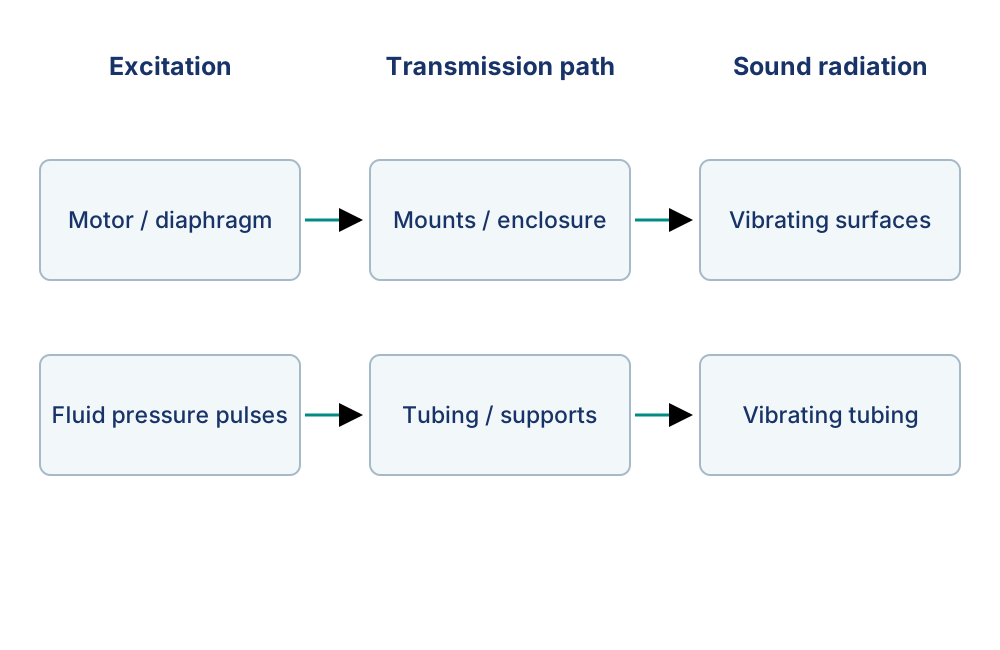
Motor rotation, the drive mechanism and diaphragm motion generate mechanical excitation. Valve operation and changing liquid pressure also excite the circuit. Energy can reach a microphone through air, or pass through supports, tube clamps, fittings and the enclosure before larger panels radiate sound.
Installation can change the pump's operating condition through poorer inlet supply, greater backpressure or unstable voltage. Alternatively, the operating point can remain similar while structural response and radiation increase. Both effects may coexist.
Reducing mechanical coupling is one approach to limiting vibration transmission. Also investigate how hydraulic pressure fluctuations excite tubing and the enclosure. Design isolation around the actual Foreach connections, mounting dimensions and load, and compare it at a matched operating point.
A decibel limit needs complete test conditions
Page 5 of the Chinese DPL30, DPL60 and DPL30H specifications states noise ≤80 dB. The reviewed documents do not provide the associated distance, frequency or time weighting, background level, mounting arrangement or hydraulic operating condition. [F1–F3]
Retain that wording. Do not convert it into 80 dB(A) at 1 m or promise the same sound level inside every instrument. A limit is also not the typical measured value of each pump.
Development comparisons can use A-weighted sound pressure at an agreed location, with spectra or original acoustic records for diagnosis. Formal acceptance should follow the method applicable to the project. Sound pressure level depends on position and acoustic field; sound power level describes emitted acoustic power. Their decibel values are not interchangeable. Record background sound, reflections and measurement settings, and keep them consistent so that changes can be attributed to the mounting or operating adjustment under study.
| Condition | Keep fixed or record |
|---|---|
| Pump and drive | Complete model, motor version, terminal voltage, speed or command |
| Hydraulic operating point | Fluid temperature, inlet/outlet pressure, average flow and bubbles |
| Mounting | Support, fixing points, isolators, fasteners, tube clamps and cable routing |
| Acoustic measurement | Calibration, microphone location, weighting, duration and background |
| Whole instrument | Enclosure state, other motors and fans, cold or thermally stable condition |
Phone recordings can help compare sound character, but automatic gain, noise suppression and microphone response affect amplitude. Uncalibrated recordings cannot establish a reduction in decibels.
Add installation elements progressively
Establish a repeatable mounting baseline, then approach the complete instrument in stages. Holding a suspended pump by hand is a poor baseline because grip and soft tissue change vibration. Use a defined fixture and record its connections.
Compare the pump with a baseline circuit, the formal support, actual tubing and clamps, and finally the enclosure. Match the working point. If a tube change alters pressure and flow, record the changed operating condition instead of attributing all acoustic differences to the structure.
| Result | Investigate first | Next comparison |
|---|---|---|
| A frequency band grows after mounting | Support stiffness, fixing and structural modes | Change support or isolation and repeat |
| Clamps or rigid connections increase noise | Tubing transmits excitation to the enclosure | Isolate connection paths progressively |
| Closing the enclosure changes sound | Panel radiation, acoustic cavity and component coupling | Compare enclosure vibration and sound spectra |
| More bubbles accompany a noise change | Inlet supply, leaks or gas release | Inlet pressure and visible circuit state |
| Speed or voltage becomes unstable | Supply, command or drive | Electrical recording and supply checks |
Make structural changes with the pump stopped. Reuse instrument positions and settings, retaining repeated measurements to distinguish environmental or assembly variation.
Use speed sweeps to investigate resonance
If the exact configuration supports speed control, vary speed within its permitted range while recording sound, structural vibration, average flow and both pressures. A narrow loud band may indicate excitation near a structural response peak; also rule out changes in valve action or supply at that speed.
Compare acoustic spectra with rotation-related frequencies, pumping cycles and control frequencies. Shaft speed determines a once-per-revolution frequency, but effective pumping events per revolution and feedback pulses require the actual mechanism and motor documentation. PWM frequency, speed-feedback frequency and fluid pulsation frequency are not interchangeable.
If a support change shifts the loud speed band while hydraulic and electrical conditions remain similar, that supports further resonance investigation. A subjective impression alone does not confirm resonance.
Validate isolation together with pump performance
A softer isolator is not always better. Stiffness, preload, load direction and excitation frequency determine performance. Excessive movement can strain connections and cables. Check bypass paths such as pump-to-enclosure contact, taut hoses or rigid clamps that reintroduce vibration into a panel.
DPL30 and DPL60 specify 3.2 mm ID hose connections; DPL30H specifies 6 × 4 mm rigid tubing with compression fittings. Do not replace the DPL30H connection with ordinary hose simply to reduce vibration. A long soft tube also changes the hydraulic system. [F1–F3]
For hydraulic excitation, evaluate appropriate damping and tubing. For panel response, compare supports, isolation and damping treatments. If adding acoustic material or enclosing the pump, check motor temperature rise, ventilation, visible leakage and service access. Retain a measure only when sound, flow, temperature and reliability meet the task together.
Compare Foreach models against the same instrument task
Brushed and brushless versions differ in life and control options, but brushless does not automatically mean quieter. Comparing DPL30 and DPL60 at their respective full-speed no-load conditions does not establish which better suits the instrument.
Compare sound and performance at the same required flow, actual backpressure, fluid and mounting. Record any different speed settings. DPL30H's higher pressure capability does not establish an acoustic advantage in an ordinary circuit.
Document the main excitation, important transmission paths, matched before/after conditions, and whether starting, flow and temperature still comply. For technical discussions with Foreach, include installation photographs, a circuit diagram and operating-point records alongside sound files.
Specifications and references
Product parameters in this article come from the Foreach specifications below. Verify engineering explanations and proposed tests for the exact model and actual operating conditions.
[F1] Foreach DPL30 Chinese specification (A04)pp. 5–6: performance and configuration; pp. 3–4: mounting
[F2] Foreach DPL60 Chinese specification (A02)pp. 5–6: performance and configuration; pp. 3–4: mounting
[F3] Foreach DPL30H Chinese specification (A00)pp. 5–6: performance and configuration; pp. 3–4: mounting
Related selection and validation guides
Frequently asked questions
If the pump becomes noisy only inside the enclosure, is the pump itself necessarily sound?
Not yet established. First compare pressure, flow, voltage and bubbles, then separate changed excitation from amplification through the installation.
Does changing to a brushless motor always reduce noise?
No. Motor and control affect excitation, while speed, pump head, structure and circuit determine the resulting sound.
Is the decibel value the only check after a noise improvement?
Also recheck working flow, start-up time, temperature rise and connection reliability, and look for new tones or start-stop effects.